We generally think of the “Enlightenment” as a time when oppressive government and religious restrictions from Europe’s “dark ages” eased up after decades of bloody conflict. The Enlightenment included a range of ideas centered on reason rather than religion as the primary source of authority and legitimacy. It advanced ideals like liberty, progress, tolerance, fraternity, constitutional government, separation of church and state, and what became known as the “scientific method” (observation, hypothesis, test, published results).
Enlightened ideas flourished in France in the 18th century, around the time of the French revolution in
Background: The Ottoman Empire
1789 and were written into the American Declaration of Independence and United States Constitution in 1786 and 1787 respectively. Leaders of The Enlightenment included Voltaire, Diderot, Rousseu, John Locke, even Benjamin Franklin, who brought back from his trips to France the newest scientific and political ideas.
But is there such a thing as “Islamic Enlightenment”? In his book, “The Islamic Enlightenment, the struggle between faith and reason, 1798 to modern times”, Christopher De Bellaigue provides interesting and often surprising answers to that question. He describes a struggle between two conflicting world views within Islamic culture, and also a struggle between Islamic culture and the more modernized and alas, exploitive western nations such as Britain, France, Germany, Russia, and more recently, the United States.
Most all middle eastern Islamic nations except Persia (later renamed Iran) were once part of the Ottoman Empire. Initially the Ottomans were leaders of Turkish warriors fighting for the faith of Islam against the Christian Byzantine state. Their capital was established at Istanbul. At its’ peak under “Süleyman the Magnificent” around 1690 the Ottoman empire reached almost to Vienna in the north, as far east as the Black Sea and the Persian Gulf, south to Yemen, and West to Algiers.
Through the 18th and 19th centuries numerous wars resulted in loss of territories, including Greece, Algeria, Tunisia, Libya and the Balkans. In the lead up to WW 1 the reduced Ottoman Empire forged an alliance with Germany hoping to regain some of the lost territories. Bad choice. In 1918 following the defeat of Germany in WW 1 what remained of the Ottoman Empire was broken up with major concessions on territories of the Empire in favor of Britain, France, Greece, and Italy. The Ottoman Empire ceased to exist and Turkey was established as an independent country under Mustafa Kemal (“Atatürk”).
Islamic Enlightenment during Europe’s “dark ages”
De Bellaigue begins his analysis with the relationship between Europe and Islam around the time of the collapse of the Roman empire. Then the new world of Islam was alive with ideas and energy, while the slightly older Christian world was collapsing into a period of intolerance, ignorance, brutal religious conflict and misery. Islam was on the march in all directions and might have conquered Europe if they had not been defeated by the Franks in the battle of Poitiers in 732. De Bellaigue describes the state of Enlightenment in the Muslim world at that time:
“At the turn of the ninth century the astronomer al-Khwarizmi popularized the use of numerals and in time confounded Western scholars with his extraordinarily advanced star tables. One hundred years later the pinhole camera was first used in experiments by the Basran al-Haytham. In the early tenth century the physician al-Razi discovered the difference between measles and smallpox; the study of algebra – from the Arabic al-jabr, meaning ‘restoration’ – was advanced by his fellow Iranian Omar Khayyam, who also composed a manifesto for hedonists, the famous quatrains…. All the while, across its varied dominions, Islam fused with its environment to create an aesthetic culture of sophistication and beauty, excelling in architecture, textiles, ceramics and metallurgy.”
But conservative elements in Islam were appalled at the idea that Muslims should find interesting and creative ideas anywhere but in the Quran. From the 9th century to the 19th century Islam fell victim to the same superstition and defensiveness that had beset much of Europe in medieval times. De Bellaigue notes:
“External threats…slowed Muslim creativity. The Crusades beginning at the end of the eleventh century were interpreted as a sign of God’s displeasure. The thirteenth century saw the reconquista of Spain at one end of the Islamic world and the Mongol invasions at the other. … these cataclysms led to doubt, introspection and a desire to win back God’s favor. It was this sense of acute danger, remediable only by replacing doubt with certainty that led to the defeat of Islam’s philosophical thinkers at the hands of their purist opponents.
…by 1580 the only observatory remaining in the world of Islam, at Galata in Istanbul, was razed on the grounds that it encouraged astrology and had angered God into sending the plague.”
Islam encounters the Enlightenment
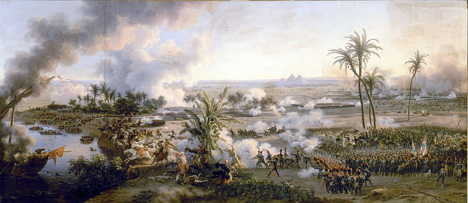
In 1798 Napoleon invaded Ottoman Egypt, which had deteriorated under the Mamluks, a military caste of ex-slaves within the Ottoman empire that ruled in Egypt until they were later massacred by the viceroy Muhammad Ali in 1811. Napoleon put ashore at Alexandria with 25,000 men and easily decimated the proud Mamluk army that came out to meet them. French superiority in weaponry, training, and tactics resulted in around one thousand Mamluks killed to around twenty nine French casualties. Following what Napoleon called, the “Battle of the Pyramids” the French established an administration in Cairo, and Napoleon invited the leading sheikhs and other notables to join a diwan, or council, to run Egypt under his supervision.
The Battle of the Pyramids, by Louis-François, Baron Lejeune, 1808.
Napoleon did more than just defeat an army and occupy a country for two years. He brought a group of intellectuals who “would act in the field of knowledge as his army had acted on the field of battle, pointing to the future and shaming the past”. This “Institute of Egypt” had an aviary, a botanical garden, an observatory, various small museums and workshops for the production of scientific tools and precision instruments. Leading Muslim intellectuals were encouraged to not only attend Napoleon’s “Institute”, but to also travel to France to spend time studying under and socially mixing with some of the leading lights of the French Enlightenment.
Focusing primarily on Egypt, Turkey, and Iran, De Bellaigue describes how these Islamic countries became aware of how far they had fallen behind European culture not only in terms of military equipment and tactics, but also medicine, literacy, agriculture, female emancipation, etc. One by one they realized that if they did not take steps to catch up, their cultures and economies were going to be increasingly dominated by the more advanced European countries (which indeed is what happened.)
Although the struggle toward modernization by each of the three countries occurred at different times and at different paces, the pattern was very similar: a serious military defeat by a modernized European country (e.g., France, England, Russia), followed by attempts by exceptional Islamic intellectuals and leaders to learn and promote enlightened policies and programs in their country or region. They would often spend years traveling and learning in France, England, or Russia and then return home to lead a period of remarkable initiatives in science, education, medicine, military equipment and training, etc.
Some Enlightenment advances that were achieved in one or more of the three countries during the 19th century include:
• Improved military training, tactics, equipment, organization, etc. • Increased literacy • Harems were phased out • The printing press and printed newspapers were introduced. The Quaran was printed for the first time. • The Turkish language, (which, though very flowery and poetic, wasn’t rich enough in medical and other scientific terminology) was greatly expanded to incorporate the full range of European terms and meanings • An imperial decree was issued to permit human dissection at medical schools over strong religious opposition • Town planning and civil engineering introduced
Inevitably the pendulum swung back. Often there was on-going opposition by extremely conservative religious and/or political leaders looking for an opportunity to discredit Enlightenment activities and to regain total power. Sooner or later there occurred a reduction or cessation of modernization activities because of the death of a progressive leader, a military defeat, an epidemic, or some other sign of God’s displeasure.
That pattern has continued to this day. In spite of the above list and many other impressive Enlightenment advances, Egypt today is governed by a military dictator after the failure of a popular uprising to get rid of the previous dictator. Turkey, after a period of progress toward democracy and separation of religion and government under Ataturk, is now ruled by a regressive elected Muslim leader and incipient dictator. Iran has an elected government, but the choices are between a conservative religious Imam or a very conservative religious Imam. Iran is enlightened enough to have missile technology and be close to developing nuclear weapons, but not enough to separate religion and government.
The Question
Why are seemingly enlightened Islamic nations continually drawn back to oppressive, destructive and
• Postal services introduced • Treatise on cholera distributed • Medical advances in Egypt under Muhammad Ali and Turkey under Mahmud II resulted in dramatic results in mortality rates due to plague. “The plague had been a feature of Ottoman life for five hundred years. By around 1850, with a suddenness that must have been stunning, transforming attitudes to life and longevity, the Ottoman Empire became a plague-free zone.” • Modern hospitals built. • Vaccinations against smallpox required • Institutions of higher learning established • Trains, telegraph and telephone communications developed self destructive patterns of behavior under dictatorial leaders in both government and religion? ISIS fighters and suicide bombers certainly don’t represent an enlightened society. Nor does imprisoning, torturing, mutilating or killing people because of religious beliefs. Continuing lethal religious conflict between Sunni and Shiite Muslims (e.g., Syria today) over a 1,200 year old argument about who is the true successor to the Prophet Muhammad does not promote enlightened governing.
There are perhaps two reasons Islamic nations have not been able to fully maintain the benefits of Enlightenment initiatives: 1.) interference and exploitation by western powers, and 2.) religion based government.
Interference and exploitation by western powers
While Islamic nations made some significant advances in modernization in fits and starts (generally with help from sponsoring advanced nations such as France, England, and Germany), unfortunately these helpful advanced nations became more and more imperial, acquisitive, exploitive, dominating and oppressive. They helped build canals, railroads, telegraph and telephone lines, but they also tended to take over government functions and national resources. For example:
Egypt and France built and operated the Suez canal connecting the Mediterranean and Red Seas. The 101 mile long canal was officially opened on November 17, 1869 in a lavish ceremony at Egypt’s Port Said. The canal took more than 15 years to plan and build, and its construction was repeatedly hindered by political disputes, labor shortages and even a deadly outbreak of cholera. But after Egypt’s overly ambitious progressive government invested too much too fast in modernization projects, Egypt had to sell out their share to pay off debts. The buyer of course was England, who wanted to protect their communications and trade routes with India. England took over management of the canal, and after that proved to be a bit inefficient, invaded Egypt and took over the country.
they needed. One month before start of the First World War, Churchill secured for the British Crown a 51 per cent controlling interest in the Anglo-Persian Oil Company for £2.2 million.
The industrial revolution in western countries among other things resulted in mass production of automobiles, trucks, tractors, airplanes, trains, construction machines etc. The oil in the ground under many Islamic nations was suddenly in great demand and a vital resource for waging war. Just prior to World War 1 Churchill converted the ships of the Royal navy from coal to oil making them faster, and much easier to refuel and maintain. Oil was much easier to store and replace at sea. Other sea powers such as Germany, France, and the U.S. were forced to do the same. But while Britain had a lot of coal, it had very little oil. However the British knew where they could get all
HMS Dreadnought (British oil burning Battleship, 1906) underway, circa 1906-07
Unfortunately, the United States also joined the advanced European nations in interfering with Islamic politics and exploiting Islamic resources. A rather recent example is the overthrow of an incipient enlightened Iranian government under Mohammad Mossaddegh by the CIA in collusion with Britain’s M16 in 1953. Mossaddegh was popular with the Iranian people, but had committed the sin of nationalizing the British run oil industry in Iran.
Religion based government
Citizens of Islamic countries are expected to adhere to Islamic beliefs and laws based on the “five pillars of Islam”. These are:
1. An affirmation that there is no deity except Allah and Muhammad is his prophet/ messenger. 2. Prayer five times per day: dawn, noon, afternoon, sunset, and night. There is a prescribed ritual for prayer beginning with washing ones hands and face, kneeling if possible or at least bowing toward Mecca while one prays.
3. Fasting during Ramadan once per year 4. Tax of 2.5% per year 5. Pilgrimage (hajj) to Mecca at least once in a person’s life time
Religion based government
These rules are enforced in many Muslim countries by Sharia law1 as interpreted by local governments led by mullahs who enforce these rules with varying degrees of severity ranging from gentle persuasion and education to physical mutilation and death. It is not easy to be a non-believer or believer in an alternative religion in many Muslim countries. There are few if any competing religions in Islamic countries. The prescribed prayer five times per day is a very visible activity; people know if you are performing it or not. In Saudi Arabia, Christian churches or synagogues are not allowed. There are no theatres or concert halls.
Extreme religious conservatism flowing out of Saudi Arabia has been a contributing factor in opposition to Enlightenment initiatives. Saudi Arabia is the home of Islam’s most sacred sites, Mecca and Medina. It is the host country for the annual Hajj pilgrimage to Mecca in which every Muslim in the world is expected to participate at least once in their life time. Saudi Arabia is also the home of the ultra conservative Wahabbi movement and contributed fifteen of the nineteen 9/11 terrorists. Wahabbism today continues to provide extreme theological nourishment to Islamic terrorist organizations such as ISIS. Islamic Enlightenment is not on their agenda.
means of transportation are segregated by sex. In court, the testimony from one man equals that of two women.
News outlets have recently featured articles about a new 32 year old Saudi Arabian Crown Prince, Mohammed bin Salman, who is determined to make some dramatic changes. Beginning in 2018 Saudi Arabia will finally allow women to drive. Women will no longer need a male guardian in the car with them. There are plans to develop a new Saudi Arabian movie industry. It will be interesting to see if this time such initiatives can succeed and endure in the home of Islam.
Not all Muslim countries are as conservative as Saudi Arabia but most all still rely on government to enforce religious laws. For example, in Iran a husband can still ban his wife from traveling internationally or working if he believes that his wife starting a job is "incompatible with the interests of the family or with his or his wife's dignity," according to the country's civil code. In 2016, Bahrain's ministry of justice released regulations stating that women younger than 45 were not allowed to go on the Hajj pilgrimage to Mecca without a male guardian.
Separation of Church/Mosque and state
Five years ago a young Saudi man, Raif Badawi, was arrested and sentenced to 10 years in prison and 1,000 lashes for daring to courageously speak in favor of secularism, democracy and reason. He is currently in his 6th year of imprisonment, has received 50 lashes and will probably not live through 950 more.2
Every Saudi woman must have a male guardian — her father, brother, husband, uncle or even son — who must give his approval before the woman can travel outside the country, get married or be divorced. The concept of male guardianship implies that women shouldn't make important decisions regarding their own lives, and that they need protection when out and about in the world. This does not change if her guardian is abusive. Many public buildings, parks and
De Bellaigue notes that the Islamic Enlightenment has never experienced an effective European style reformation in which entrenched religious beliefs are successfully challenged by alternative explanations for natural events. There is no centralized authority in Islam comparable to the medieval Vatican. There is no single door where a dissident Muslim Luther can nail 95 theses challenging oppressive religious authority. Prior to the European reformation it was assumed that the primary responsibility of governments on earth was to help God enforce religious laws on earth, often by torture, imprisonment, and death. By revealing human corruption in the Catholic church and challenging the church’s authority in certain areas of theology, reformers were able to establish alternative forms of belief and worship.
1 English Oxford Living Dictionaries: Islamic canonical law based on the teachings of the Koran and the traditions of the Prophet (Hadith and Sunna), prescribing both religious and secular duties and sometimes retributive penalties for lawbreaking. It has generally been supplemented by legislation adapted to the conditions of the day, though the manner in which it should be applied in modern states is a subject of dispute between Islamic fundamentalists and modernists.
2 Reported by the Freedom From Religion Foundation
Through years of strife and bloodshed in Europe, this reformation eventually led to the idea of separating religion and government.
This new idea in governance was first enunciated and actually implemented by Roger Williams in the charter for the new colony of Rhode Island in 1643. Williams was a young Puritan theologian who believed that local magistrates had no authority to enforce “the First Table”, meaning the first four of the Ten Commandments (as numbered by Calvinists and the Church of England.) Williams had reached a conviction that these commandments defined human duty to God, namely: to have no other God before Him, to make no graven images, to not take the Lord’s name in vain, and to keep the Sabbath holy. This was a radical idea at the time. He wrote:
“As long as the mullahs interfere in the affairs of the Ottoman government, it shall make no progress. Sultan Selim made an attempt to introduce the European order in Istanbul but the mullahs stupidly called this order non-Islamic. The Sultan also wanted to introduce European science but the mullahs again through jealousy prevented him and thus kept the people from leaving the path of ignorance and darkness. In fact, it is obvious that whenever the mullahs interfere in the affairs of any government, that country and that administration shall never make progress.”
“The state…had no authority to inject itself in any way into an individual’s relation-ship with God. It must enforce only the commandments in the “Second Table”; those which govern human relations, such as the injunctions forbidding murder, theft, lying, adultery, and covetousness”.
Around 150 years later the separation of religion and government was written into the U.S. Constitution and Bill of Rights by Thomas Jefferson. This principal has since been adopted in the governments of many nations, but not in Muslim governed nations.
Crown Prince Mohammed bin Salman
There is much discussion about whether or not Islamic countries, to fully realize the benefits of an Enlightened society, must experience some type of reformation that will result in constitutional governments in which religion is separated from government. I don’t know if this is likely or possible, but there have certainly been Islamic thinkers who have given voice to such heretical thought. De Bellaigue quotes a Muslim intellectual named Mirza Saleh who was sent on an educational mission to Russia and England in 1815. On the return trip Saleh spent time in Istanbul where he wrote:
De Bellaigue sums it up this way:
“The question was how to embrace constitutionalism, with its accent on representation, religious equality, and the separate spheres of authority, without destroying Islam.”
That still is the question.
3 Roger Williams and the Creation of the American Soul, by John M. Barry
Creative Credits
- Written by
- Edw. Carstens