
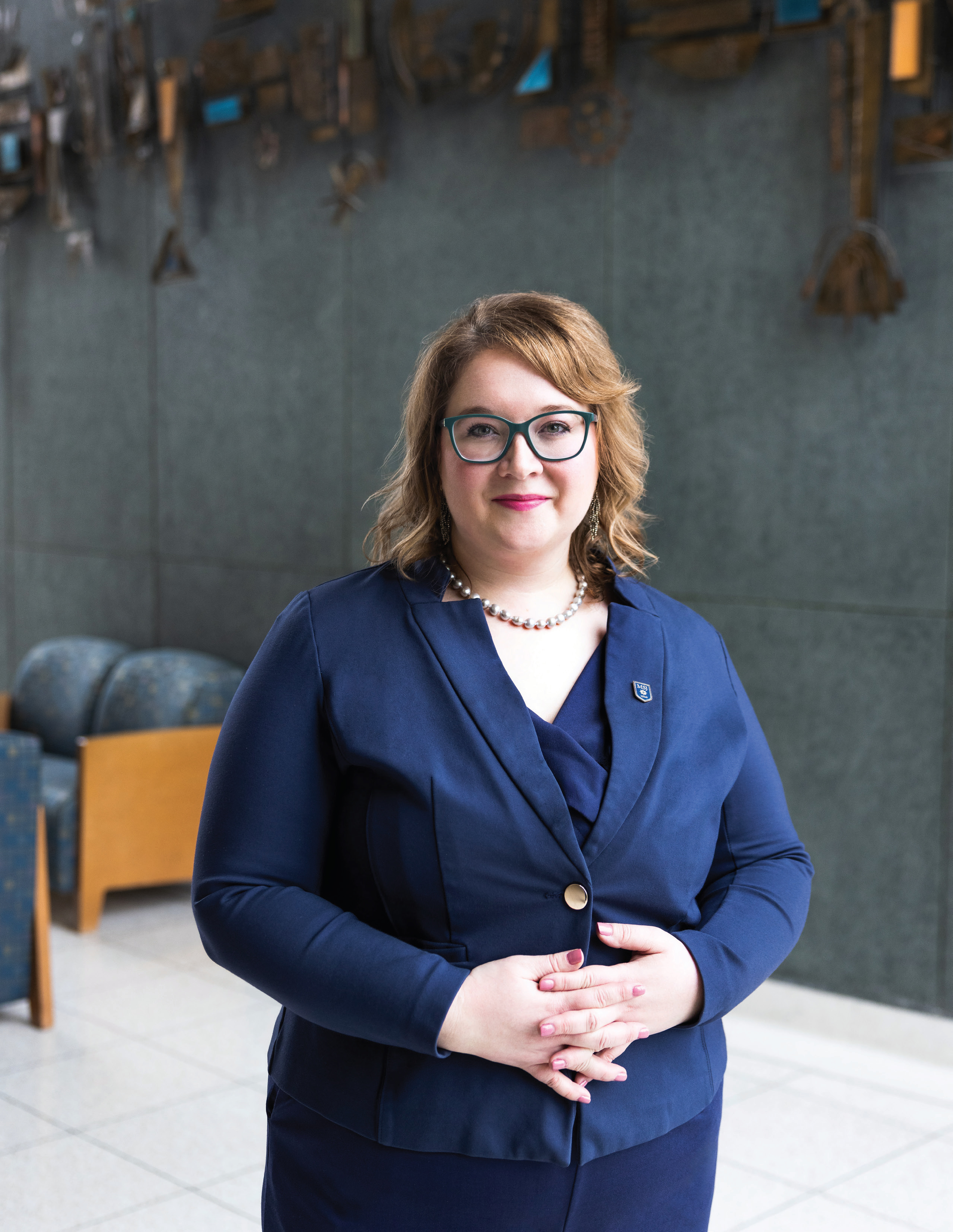
Portraits of Sydney M. Prochazka by Meagan Shuptar Photography of the the Mater Dei Chapel provided by Mount St. Joseph University Senior Editor, Laura Notorangelo
Unquestionably, the Mater Dei [Mother of God] Chapel, situated on the Cincinnati campus of Mount St. Joseph University, is a jewel of mid-century architecture. Beyond its breathtaking design, the collegiate chapel, completed in 1962, unveils a story of remarkable significance: it is the first entirely female-designed Catholic chapel in the United States. The faculty and staff of Mount St. Joseph University are on a mission to secure the Mater Dei Chapel's sacred art on the National Register of Historic Places in honor of the profound legacies of the women who designed and created the Chapel: the University’s Art Department Chairperson at the time, Sister Augusta Zimmer S.C., Sister Ann Austin Mooney, Sister Loretta Ann McCarty, and art students Margaret Rolfes Brungs, Judith Dettenwanger Ebbeler, and Marlene Hoffman.
All signs suggest the Mount’s Mater Dei Chapel will become a nationally recognized landmark. But even more importantly, the potential honor has ignited a resurgence of support and a desire to preserve the chapel as a symbol of progress and a living testament to the indomitable power of art to transcend boundaries and effect change. Through the lens of Mater Dei Chapel, we are invited to witness the stories of these remarkable barrier-breaking women, who, through their creativity and dedication, left an indelible mark on both their community and, possibly, the Nation.
When you walk into the chapel on a sunny afternoon, the large west stained-glass windows illuminate the sanctuary in prototypical 1960s gold and amber harvest tones, accented by pops of jeweled sapphire, ruby, and royal purple. A long green and black terrazzo center aisle separates the two columns of pews. Directly behind the altar and bronze-sculpted crucifix is a twelve-foot by twenty-seven-foot-high reredos, handcrafted of 130,000 Venetian glass tiles, painstakingly sorted by Art & Design majors after the tiles were flown in from Venice, Italy. Most of the glass squares are one-square-inch wide, with a few larger glass tiles incorporated periodically. The reredos’s tiles form an image of Jesus’ spirit surrendered and rising upwards towards the image of a dove, symbolic of the Holy Spirit in the Christian faith, just behind the large bronze crucifix.
An alumna Trustee of the University’s Board recently reflected on her experiences in the “new” Mater Dei Chapel when she was a student in the Class of 1966. She described how one tile became a metaphor for her experience at the college. During moments of prayer, her gaze would often be drawn to a particular tile in the reredos, larger than the typical one-inch tiles and almost white in hue. Initially, she felt a sense that she did not belong in college and was out of place, much like the conspicuous tile. However, as her journey at the college unfolded, her perspective shifted. The tile that once seemed disconnected from the larger artwork became a focal point of reverence. Each tile, meticulously placed by artist Margaret Rolfes Brungs, carried its own unique character. Yet, when integrated into the grand mosaic of the reredos, they formed a cohesive and harmonious whole. In time, the alumna realized the same could be said of each woman at the Mount who was contributing her distinct qualities to a greater, shared narrative of empowerment and belonging.
Rolfes Brungs showcased her artistry not only in the creation of the reredos but also in the design and crafting of the Venetian glass mosaic Stations of the Cross. Drawing inspiration from the vibrant hues of the surrounding stained glass windows, she imbued the Stations with vivid colors that echoed the Chapel's aesthetic harmony.
During a visit to the Mount in 2022, Judith Dettenwanger Ebbeler underscored the significance of Rolfes Brungs’ portrayal of Jesus in her artwork. Dettenwanger Ebbeler emphasized that Rolfes Brungs’ depiction marked a groundbreaking departure from convention by portraying Jesus as a Jewish, Middle Eastern man—an innovation particularly notable, given Rolfes Brungs’ status as a young female student in the 1960s. Noted in the Mount’s proposal for the National Register of Historic Places, Rolfes Brungs’ choice to incorporate a diverse palette of deeper colors -tans, khaki, burgundy, olive, orange, and cinnamon tones – to achieve a revolutionary representation of Jesus's skin tone, challenged traditional depictions of Christ prevalent before the Civil Rights movement. Rolfes Brungs’ sensitivity and artistic choices contributed to a more inclusive and culturally resonant portrayal of Jesus Christ.
The twenty-eight stained glass windows, strategically positioned to make the most of the southern exposure, refract the light onto neighboring bricks and the terrazzo floor, creating a dynamic interplay of light and shadow that evolves with the changing daylight. The subtle intricacies in the art are revealed gradually over time, rendering it impossible to absorb them all in a single visit fully. Still, they continue to captivate and draw in generations of students, faculty, and staff who visit the chapel – which is likely what Sister Augusta had in mind when she designed it.
Also included in the National Register for Historic Places proposal is the story of artist Marlene Hoffman, who dedicated one year to designing and producing the stained glass windows. She began by crafting small sketches, which she translated into full-scale patterns for each panel. These patterns were hung from a 4th-floor classroom window in Marian Hall, the original college campus situated on the property of the Motherhouse of the Sisters of Charity, to be evaluated. Upon approval of her final designs by Sister Augusta, Hoffman, along with Dettenwanger Ebbeler, traveled to West Virginia to hand-select glass pieces from the renowned Blenko Glass Company. Notably, the Blenko Glass Company stood as the sole institution willing to collaborate with female students (as documented in Mount St. Joseph University’s archive).
While the once-women’s College of Mount St. Joseph was founded by the Sisters of Charity of Cincinnati in 1920, the “new campus” was commissioned in the early 1960s amidst a time of political and social change, both within and outside the Catholic Church. Quoted in the application for placement on the National Historic Register, Dettenwanger Ebbeler stated, “Mater Dei Chapel was designed, furnished, and decorated by the vision of Sister Augusta under the title ‘Mother of God.’ She was inspired by the words of Pope John XXIII during the opening of the Second Vatican Council when he called on Mary under that title to watch over the Church during the work ahead.” The art and style of the Chapel, directed by Sister Augusta Zimmer, certainly reflects the times and the persons who used the space.
Coming into the hallway serving as both a campus thoroughfare and the narthex, a stone statue of Mary, the Mother of God, and her son Jesus, designed by student artist Marlene Hoffman, greets visitors. This statue exudes a warmth and playfulness uncommon for other representations of Mater Dei during this period, as noted in the application. In the sculpture, a young Jesus stands on Mary’s lap, extending his arms outward in a gesture reminiscent of a mother affectionately asking her son, "How much do I love you?" and receiving the endearing response, "This much," with arms outstretched.
As Sister Augusta undertook the design of a modern chapel on the new campus, the world outside was undergoing a significant shift in the perceptions of women's capabilities. Sister Karen Elliott, C.PP.S., Chief Mission & Belonging Officer at the Mount, observed that it was only at this pivotal moment in time, coinciding with the Second Vatican Council, that “[i]t would have been possible for Sr. Augusta and her students to emerge as design leaders in a field predominantly controlled by men.” The sacred art, designed and created entirely by women under the direction of a respected female artist and teacher, Sister Augusta, symbolized a tremendous social transformation. Seven years ago, Sister Karen took up the mantle of preserving these sacred treasures and legacies when she was in charge of a Chapel needing repairs. When she arrived, the Chapel was over 60 years old. “We have these big football players here now; I would hear the pews creak and groan under their weight and be concerned,” she said. While praying, she asked Sister Augusta to send her help if she genuinely wanted to do more for this sacred space. During a prayerful reflection, an unexpected incident occurred—her phone slipped off the pew and slid under a kneeler, prompting Sister Karen to get on her hands and knees to retrieve her phone. What she saw as she reached for her phone seemed like a clear answer to her prayers and a sign from Sister Augusta herself. She discovered a deep fissure in the wood of the pew's support, signaling a pressing need for immediate action to prevent further structural damage or even injury. Since then, Sister Karen hasn’t stopped telling anyone and everyone about the Chapel and the women who created it.
Sister Karen’s first victory came in 2019, when she successfully demonstrated, with the help of Sister Augusta according to her, the need for the University to provide for the restoration of the pews, kneelers, flooring, and the repair of the fourteen mosaic Stations of the Cross, which the University funded. Presently, Sister Karen collaborates with a team of dedicated Sisters of Charity, historians, a historic preservationist, and faculty and staff. Together, they are working to update the “vintage” sound and lighting system, preserve the stained glass windows, replace the organ, and secure the Chapel for future generations.
Sister Karen has also prioritized accessibility, such as accessible entrances and modified bathrooms, in her campaign to bring the Mater Dei Chapel into the twenty-first century. Through her impassioned written and verbal appeals, she has raised an additional $150,000 for the restoration needs. Combined with an additional $330,000 the Mount has allocated, these funds constitute a promising start toward her financial objective, albeit with a remaining deficit of several hundred thousand dollars. Nonetheless, Sister Karen knows her mission is more than restoration, and that makes her relentless in her pursuits. Determined to preserve the heritage of the Mount by way of preserving the Chapel, Sister Karen partnered with Maddie Williams, Director of Preservation and Historic Rehabilitation at the Cincinnati architecture firm MSA Design, to find new ways to share the beauty of the Mater Dei Chapel. Quickly recognizing the historical and architectural significance, in addition to the religious and cultural importance, Williams encouraged the University to move forward with an attempt at a historical designation. In July 2023, the nomination application was submitted to the Ohio State Historic Preservation Office.
Reflecting on the application process and the significance of honoring the artists, Williams noted, “At least once a day, I reflect on the three young women designers and Sister Augusta. The thought of their accomplishments makes me feel rejuvenated and inspired. To achieve such greatness during the time when women were not accepted into the art community shows what true courage and spirituality look like. They have become enduring heroes in my professional and personal life. I felt honored to play a role in documenting the story of the modern-day chapel and celebrating the accomplishments of Sister Augusta and her students. Over 60 years later, they continue to inspire us through the artistic talents demonstrated in glass, mosaics, clay, wood, metal, and ceramics.”
Months later, Williams and Sister Karen traveled to Columbus, Ohio, on December 8, 2023, for the Solemnity of the Immaculate Conception – one of the most important Marian feasts for Catholics – to answer questions and present their proposal to the Ohio State Advisory Board, who would vote to move Mater Dei Chapel forward for consideration to be added to the National Register of Historic Places. In timing that seemed providentially aligned, the Ohio State Advisory Board unanimously approved Mater Dei Chapel’s consideration for placement on the National Register of Historic Places. Currently, the proposal is waiting in Washington, D.C.
If the National Park Service approves the Mount’s proposal and selects the Chapel as a location of "exceptional historic value," the Mater Dei Chapel will be listed on the National Register of Historic Places. This designation would guarantee the Chapel's conservation, safeguarding the sacred artwork within and ensuring its legacy for future generations. The Mount’s proposal will also find its place within the Library of Congress, immortalizing its female designers’ names and legacies.
While awaiting formal acceptance from the National Park Service, Sister Karen has organized a gathering of alums, Sisters of Charity members, and former and current faculty and staff. This March 19th, on the Solemnity of St. Joseph, the patron of the Sisters of Charity, those gathered will worship and celebrate in the Chapel. Two alumnae artists whose contributions propelled the chapel towards its potential future listing on the National Register of Historic Places will fly to Cincinnati for the celebration. After all, the Mount community has orchestrated a special event to honor what they have consistently recognized as a national treasure—the inspirational alumnae artists behind Mater Dei's design.
If you would like to financially support the preservation of Mater Dei Chapel, please visit www.
This article would not have been possible without the work of historian Sister Judith Metz, SC and Madeline Williams, the primary authors of the National Register of Historic Places proposal, and the many librarians and other dedicated faculty and staff members who championed Mater Dei Chapel.
Update: At the time of publication of this article, Mount St. Joseph University’s iconic Mater Dei Chapel was officially named to the National Register of Historic Places by the United States Department of the Interior on March 8, 2024.
+Sister Augusta Zimmer, interview by unknown, Sisters of Charity Archives.
Creative Credits
- Written by
- Sydney M. Prochazka
- Image courtesy
- Mount St. Joseph University
- Photography
- Don Denney Photography
- Photography
- Meagan Shuptar
- Photography
- Andrew Rasmussen
- Creative Credit
- Mount St. Joseph University