Opening: Friday, April 1, 2022 April 1 – June 20, 2022 From April 1, from 6.30pm till 9pm
To commemorate the opening of its new premises to the public in conjunction with the centenary of the artist's birth, Archivio Scanavino presents Emilio Scanavino. This is Tomorrow, an exhibition curated by Marco Scotini running from 1st April-20th June 2022.
One of the masters of Italian painting in the second half of the twentieth century, Emilio Scanavino (1922-1986) was – although descriptions like this are always rather incomplete – one the leading figures of the so-called Art Informel generation and Spatialist movement that emerged in the aftermath of the Second World War. Scanavino's distinctive style – graphic and sculptural, physiological and tangible, organic and abstract – was focused for over thirty years on creating his own alphabet and alternative language whose ‘words’ did not lie. A language to be deciphered rather then read in such a way as to constantly showcase the artistic medium and the secrets its signs held. In this sense, Scanavino is like a Champollion from the Cold War period.
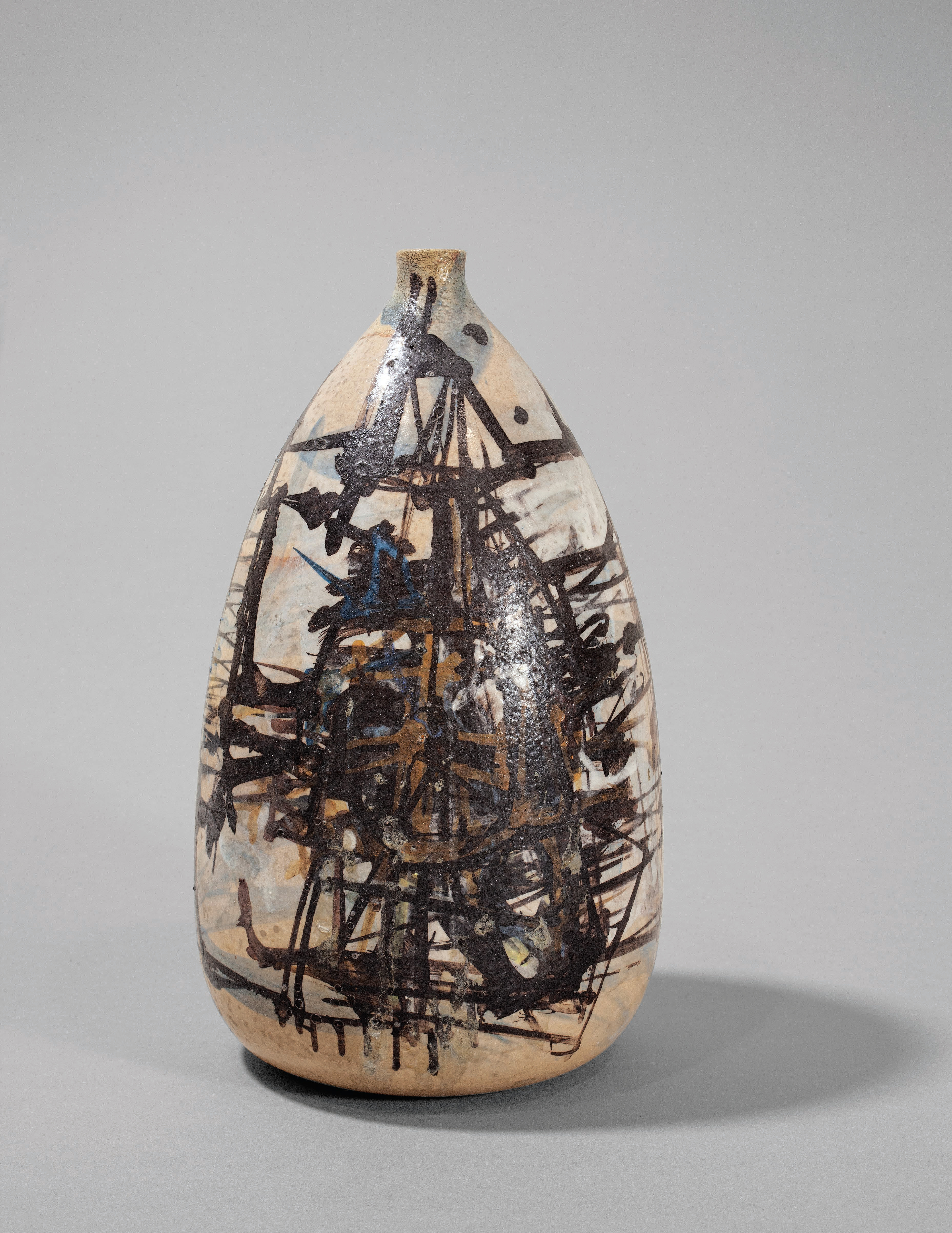
Showcasing more than 60 glazed terracottas, slipware, majolica and metal objects designed between the early 1950s and the end of the 1960s, Emilio Scanavino. This is Tomorrow is a unique opportunity to discover the artist's relationship with polychrome ceramics and to explore his studies into key stylistic issues more closely. The exhibition is the first project devoted to this specific side of his work, often neglected because it tends to be encompassed in Scanavino's sculptural projects.
The title of the exhibition refers explicitly to This is Tomorrow, one of the seminal exhibitions of the post-World War II period, curated by Bryan Robertson. This collaborative exhibition bringing together painters, sculptors, architects, designers and other artists opened at Whitechapel Art Gallery in London in 1956 with Emilio Scanavino being the only Italian artist involved. Designed to promote closer ties between art and architecture, Scanavino worked with the architect Anthony Jackson and sculptress Sarah Jackson during the London exhibition as a continuation of a successful partnership that had already seen a double solo show of the Italian artist’s work in conjunction with Sarah Jackson held at Apollinaire Gallery in London in 1951.
The exhibition held at Whitechapel Art Gallery marked the culmination of his focus on bringing together art and architecture, which later led him to work with architects like Mario Bardini and Ettore Sottsass, who would later review his work in Domus (1964) and who wrote to him in 1954 about a possible working partnership: "I believe that the idea of architecture that is distinctly sculptural and more in keeping with the spirit of our times, drawing on the latest sculptural ideas that are cropping up everywhere, is not an outlandish or merely romantic idea. It would be nice if we could do something like this together for the first time."
Focusing on the artist's manual dexterity and his relationship with architecture, Emilio Scanavino: This is Tomorrow aims to offer a more modern interpretation and fresh focus on the Genoese artist’s work, taking a closer look at not only Scanavino's working partnership with the well-known manufacturer, Mazzotti, based in Albisola, but also with artists of the calibre of Lucio Fontana, Roberto Matta, Wilfredo Lam, Asger Jorn and Corneille.
The exhibition is accompanied by a catalogue edited by Marco Scotini in conjunction with the Scanavino Archive and published by Silvana Editoriale. Focusing on ceramics, the book sets out to cover an aspect of his work overlooked in numerous previous publications about Emilio Scanavino to help provide a more complete picture of this great artist.
Emilio Scanavino was born in Genoa in 1922, where, after attending a school specialising in the arts, he immediately turned to painting, opening his first solo exhibition of expressionist works in 1942. After initially focusing on figurative paintings, Scanavino's work gradually veered closer to post-cubism, gradually synthesising forms until they vanished. After spending time in Milan, Paris and London, in 1950 he began working with Tullio Mazzotti at his ceramics manufacturing firm in Albisola together with Lucio Fontana, Sebastian Matta, Guillame Corneille, Asger Jorn, Wilfredo Lam, Gianni Dova, Roberto Crippa and Enrico Baj. In the same year, he exhibited at the 25th Venice Biennale and was awarded Joint First Prize at the 5th Regional Exhibition in Genoa. He spent some time in London in 1951 in conjunction with an exhibition held at Gal rie Apollinaire. In summer 1955 Scanavino took part in Phases de l'art contemporain held in Paris and a solo exhibition of his work was hosted at Galerie Apollo in Brussels in March the following year with an introductory presentation written by Christian Dotremont, a key figure at CoBrA. He made the acquaintance of Carlo Cardazzo in Albisola, who at that time had already begun to promote a new circuit of contemporary art (extending from Milan to Venice) of a distinctly avantgarde nature. Cardazzo’s Galleria del Naviglio hosted Fontana’s first Spatial Environment and the first European solo exhibition of Jackson Pollock’s work.
In 1954 he exhibited at the Venice Biennale again. He also took part in the 1958 event and was awarded the Prampolini Prize in 1960 with his own personal exhibition room. He also went on to win the Pininfarina Prize at the 1966 Biennale.
Over the following years he continued to exhibit his work on the international scene, taking part in numerous exhibitions in London, Paris, Milan, Tokyo, Mexico City, etc.
After being invited to taken part in the XI Biennial of S o Paulo in Brazil in 1971, he created a large work dedicated to the martyrs for freedom working in partnership with the sculptor Alik Cavaliere, but the work was banned from being exhibited after being censored by the consulate because its subject matter was "of a political nature and therefore non-artistic". In 1973 the Kunsthalle in Darmstadt presented an extensive anthological exhibition of his work, which was later shown at Palazzo Grassi in Venice and Palazzo Reale in Milan in 1974.
In 1975 he took part in X Quadriennale in Rome and then the following year he began working with Giorgio Marconi in Milan. He subsequently travelled back and forth between Italy and Paris but eventually had to stop travelling to Paris for health reasons at the end of the 1970s.
He then lived and worked in Milan and Calice Ligure up until his death in 1986.
More information: archivioscanavino.it
Creative Credits
- Written by
- Lara Facco
- Creative Credit
- Bruno Bani
- Creative Credit
- Archivio Emilio Scanavino