On a heavy August night in Chicago’s West Loop, the hum of ice in highball glasses mingled with the thrum of guitars that hadn’t been played in decades. Inside After—Chef Curtis Duffy’s cocktail temple of dim light and sharp edges—the air felt charged. Photographs of Nirvana, Nine Inch Nails, and Pearl Jam pulsed from the walls, each one a small detonation of memory. The room smelled of cedar smoke and citrus peel. People whispered names that once belonged to teenage bedroom posters. It was the private preview of Alternative Nation: A Retrospective—a show that refuses nostalgia, preferring to drag the 1990s underground into the light of now.
Curated by Stephen Dallimore of Behind The Gallery, the exhibition gathers five photographers whose lenses wrote the visual language of that decade: Joseph Cultice, Jonathan Rach, Chris Cuffaro, Kevin Westenberg, and Scarlet Page. Their work captured a generation at its most electric—when rebellion was style, and imperfection became proof of truth. “That’s easy,” Joseph Cultice said when asked what drew him to artists on the fringes. “These kinds of pop stars are the most interesting.”
He has photographed everyone from Björk to Marilyn Manson, but it began far from fame—in the Arizona desert, shooting his neighbors, the Meat Puppets. “They lived down the street from me,” he remembered. “They even played in my living room at my 19-year-old legendary punk rock house, Club Mayhem. They were warm, open humans who let me into their world and gave me a reason to shoot.”
Cultice’s career, like his images, walks a line between grit and glamour. “Pop stars want to look real, but they also want to be sexy,” he said with a laugh. “For me, it’s about adding just a touch of grit—‘a little crunch,’ as I like to say.” When asked about that balance, he grinned. “Honestly, I’m really bad at beauty lighting, so grit comes naturally.”
At After, one of his Smashing Pumpkins portraits drew a small crowd—a calm, almost glossy moment of three musicians who, by then, were already too big for any club. Cultice remembered it differently: “MOJO had assigned me a cover shoot. Jimmy was on vacation, so it was just the three core members. The session felt calm, very much a ‘pop-star’ event. Billy asked about KOMEDA, a band’s music I was playing. He liked discovering new music at shoots like mine—that was an added plus. Later, Billy and I became good acquaintances, largely through our mutual friendship with Manson.”
Chris Cuffaro’s world was louder. He arrived in Seattle just as grunge began to crawl out of its bars. “I was only a visitor to Seattle at that time,” he said. “I was an outsider welcomed in by the bands, musicians, creatives, and labels. I could sense that it was special—you felt it at the shows and shoots.”
He remembered flying home to Los Angeles, trying to explain the storm brewing in the Pacific Northwest. “When I would come home, everyone would ask me who I saw play live and shot while I was there. The buzz was real and fun.”
His photos—Nirvana against a dumpster, Chris Cornell alone in the desert—carry the vulnerability that powered the scene. “Either the first shoot with Nirvana on the dumpster or Chris Cornell standing in the middle of the desert doing ‘Jesus Christ Pose,’” he said when asked to choose one image that defined grunge’s heart. “Those two images are strong and grunge.”
Cuffaro still sees that energy connecting generations. “You gotta remember… For a good six to eight years, grunge ruled radio, TV, and live concerts. It was BIG! It affected a lot of generations.”
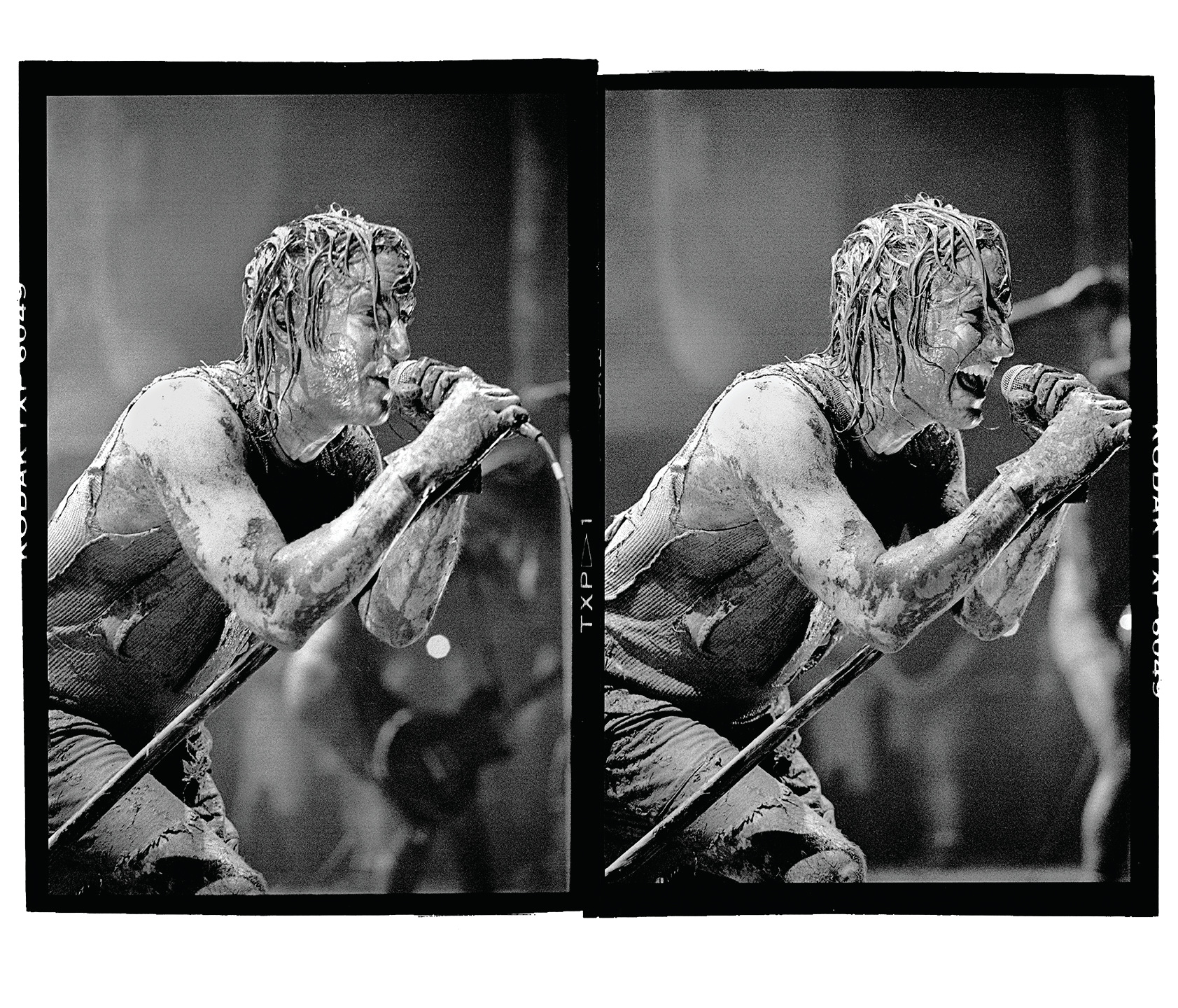
If Cuffaro’s Seattle was raw muscle, Jonathan Rach’s world was pure voltage. In 1994 he joined Nine Inch Nails on the Self Destruct tour—a traveling fever dream of sweat, noise, and transcendence. His images from those years, later featured in the band’s Closure documentary, are the show’s dark heart.
“When I took these photos back then, I had not realized their significance in the music history archives,” he said. Living with the band day in and day out, he captured what most cameras would miss. “I was never once told what to document and what not to document. I tried to capture the energy in its raw truth.”
He described the trust that made those moments possible. “You are invited into the nucleus of the artist’s world,” he said. “The group consisted of five band members, accompanied by a tour manager, a bodyguard, and myself. That was it for years. You become friends and just maneuver as you would with any circle of valued relationships.”
Rach’s quiet humility belies the history he helped shape. “As time goes on and you have this experience to look back on, you do start to realize how special it all was and how important the images have become for future generations,” he reflected. “That is the power of photography.”
Across the Atlantic, Kevin Westenberg was giving the same era its cleanest edges. His portraits of Soundgarden, Pearl Jam, and The White Stripes bridged the chaos of the stage and the poise of the magazine cover.
“After 40 years of taking photos and absorbing the whole of the world’s visual medium of film and photography, osmosis and wisdom happens,” Westenberg told Félix. “The goal is to always show the best side of any subject or landscape.”
His relationship with Soundgarden stretched from their early days at Sub Pop to the band’s final album before their 1997 break-up. “Their persistence in hiring me while we were both in our prime learning years was the main reason the photos kept getting better and better,” he said. “Once they started seeing results they liked, this was the foundation that helped everything expand and flourish.”
He recalled shooting The White Stripes for MOJO—Jack White’s favorite magazine at the time. “The stakes were high for us and them,” he said. “The tension and stress on the day was amazing—just like I like it. There’s always going to be some fantastic moment that occurs in those circumstances.”
If the men caught chaos, Scarlet Page captured grace. The daughter of Led Zeppelin’s Jimmy Page, she carved her own place in rock photography through empathy, not legacy.
“Most of the images in this exhibition are either live or quite direct,” she explained. “But a couple stand out as more candid. The Foo Fighters image on the beach is one—I was far back using a long lens, so I couldn’t hear what they were laughing about, but I caught that moment mid-laugh when they were just being themselves.”
Page’s approach is deceptively simple: connection. “I always want the image to feel authentic, even if we’ve set something up for a promo,” she said. “My aim is to put people at ease so I can get to something real.”
Her portraits of the late Chris Cornell radiate affection. “Some of my images of Chris have made people cry,” she admitted softly. “He had such an incredible presence, and he was actually the first artist I had published in print, so he’ll always have a special place in my heart.”
For Page, analog photography’s imperfections are part of the magic. “I think there’s a real hunger right now among younger fans for ’90s bands,” she said. “That era is having a moment again, and classic images still cut through the noise.”
Then there is Stephen Dallimore, the man who threaded all these visions into one. Standing in the back of After, he watched people lean toward the photographs as though listening for sound. “It’s a testimony to a period in music that was fresh, exciting, and dangerous,” he said. “We didn’t have social media telling us about artists’ everyday lives. The less we knew, the more interesting it was.”
He spoke of film photography with reverence. “The archives from this period are like untouched gems,” he said. “Most of it was shot on film, not digital. There’s something to marvel in that.”
His intent, he said, was never to indulge nostalgia but to reveal connection. “At Behind The Gallery we’re privileged to work with so many amazing photographers,” he explained. “For this show, each one offered a different perspective on the artists through their own style. They all had a connection with the people they shot, and that’s important.”
He wanted to create a visual journey—live moments, behind-the-scenes, portraits—that captured the energy of an era before constant exposure. “Younger fans today want realness and authenticity in such a digital age,” he said. “They’re nostalgic for an era that’s not theirs, and that can help build emotion, understanding, and identity.”
Dallimore’s decision to open in Chicago was deliberate. “Chicago has such a rich history—Louis Armstrong, Muddy Waters, Curtis Mayfield, House music, Wax Trax!” he said. “It felt like the right place. Chef Curtis Duffy is a massive music fan and wanted to help support the show. Through the venue After, it came alive.”
As Alternative Nation prepares to travel, Dallimore envisions it like a tour itself. “Historically, these types of exhibitions happen in LA or New York,” he said. “But I think it’s important to move them around—bring them to people in different parts of the country. The ultimate goal would be a display that showcases all the work, all the photographers together, for a massive panel discussion.”
“Each of these images is a kind of time capsule,” he added. “They remind us of what it looked like to feel something.” And that may be the true essence of Alternative Nation. These photographs don’t just remember a decade—they resurrect its pulse. The grain of film becomes rebellion’s fingerprint. The sweat, the shadow, the laughter—all proof that imperfection is where beauty begins.
Visitors lingered before images like Dave Grohl’s unguarded laughter on a windswept beach—moments that still feel alive decades later. The exhibition invites every generation, whether they lived through the music or discovered it on vinyl reissues, to feel that pulse firsthand.
Art, like memory, doesn’t age—it only deepens. And this show, born of noise and grace, reminds us why the 1990s still matter: because they taught us that to be authentic is to be unafraid.
About the Photographers
Joseph Cultice’s lens has spanned from the Phoenix punk scene of the Meat Puppets to international icons like Björk and Marilyn Manson, blending grit and glamour with unmistakable humor.
Chris Cuffaro, based in Los Angeles, built his reputation through definitive portraits of Nirvana, Soundgarden, and countless cultural figures over a 35-year career that continues to evolve.
Jonathan Rach’s imagery of Nine Inch Nails became part of music history itself, complementing a film and directing career rooted in storytelling and authenticity . Kevin Westenberg, a London-based MOJO contributor for more than two decades, has chronicled everyone from Sting and Soundgarden to Radiohead with a mastery of light and composition.
Scarlet Page, whose early tours with The Smashing Pumpkins and The Beastie Boys defined her reportage style, continues to photograph artists and cultural leaders worldwide, her portraits balancing intimacy and strength.
All photography available via Behind The Gallery (www. behindthegallery.com.au) | Instagram @behindthegallery_.
Creative Credits
- Written by
- Elizabeth Harms
- Photography
- Joseph Cultice
- Photography
- Jonathan Rach
- Photography
- Chris Cuffaro
- Photography
- Kevin Westenberg
- Photography
- Scarlet Page
- Creative Credit
- Behind The Gallery