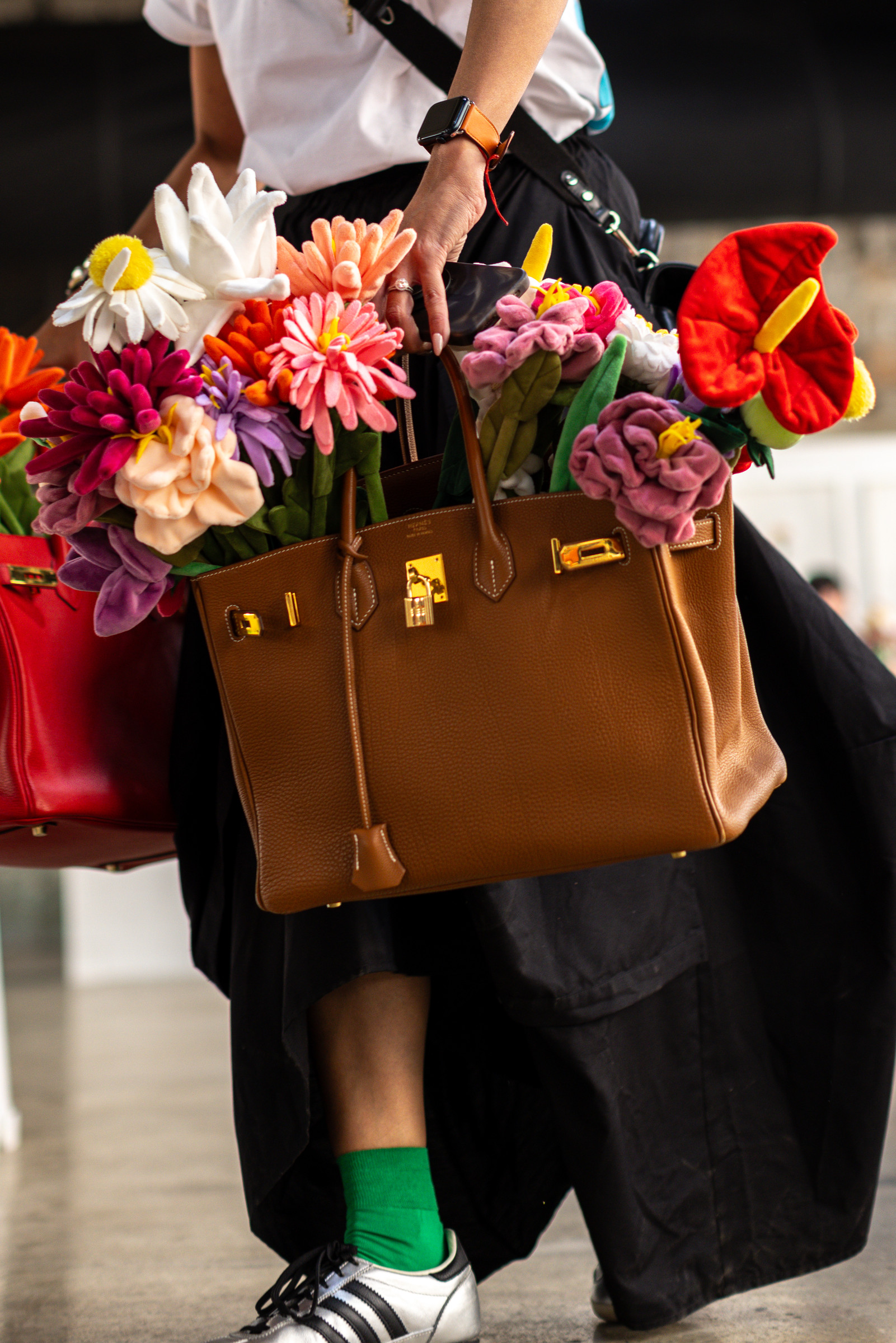
The handbag is doing the work of a vase. In Antonio Ajam’s photograph, a red plush bloom tilts above tan leather and gold hardware. Orange petals crowd the handles. A perfectly serviceable handbag has become a flower bucket.
The image comes from an earlier presentation of Cj Hendry’s flowers, before the Flower Shop pop-up scheduled for Chicago this December. It catches a stage of the work that an exhibition photograph can easily overlook: the display has become somebody’s arrangement. The flowers have left their rows and found other containers.
For an artist known for hyper-realistic drawings, Hendry has found a remarkably portable way of inviting people into her work. Her plush flowers retain enough of a bloom’s familiar outline to be recognized at a glance. Closer inspection gives you fabric, folded leaves and soft petals. You can see how the illusion is put together. You can also put several of the objects in a bag.
The prototype problem
A fake flower can fail. Hendry has said so, with some feeling.
Reporting on the original Flower Market in 2024, Artnet’s Vittoria Benzine described Hendry rejecting nearly half the prototypes presented to her. “Like the bird of paradise. It looked so heinous,” the artist told Benzine. “Heinous” is a satisfyingly severe verdict on a fake flower.
The studio photograph of a single red bloom shows how little there is to disguise a bad decision. Folded green leaves break up a long, fabric-covered stem; the cupped head has to remain recognizable without its neighbors. There is nowhere to bury an awkward proportion.
Hendry’s drawings ask for a different kind of close attention. Their painstaking realism makes an ordinary object worth looking at again. At Flower Market, the drawing and the take-home object appeared within the same project. Benzine reported that the 2024 installation included a dozen original floral drawings available only to existing collectors, while visitors could leave with a plush stem. There were different ways into the work, and very different things to carry away.
That first Flower Market opened on Roosevelt Island in New York in 2024 and relocated to Industry City in Brooklyn after overwhelming demand. The project later reached Rockefeller Center. Flower Shop now extends the idea through permanent shops in New York and Hong Kong and a planned fourteen-city pop-up tour. The Chicago stop belongs to that traveling retail format.
The change in format gives the individual flower more responsibility. An installation can make its effect through a roomful of color. A stem taken home has to hold up beside the things a person already owns. In Ajam’s handbag photograph, the red fabric bloom dwarfs the bag’s metal clasp.
Chicago’s next bouquet
Flower Shop is scheduled to open at Loft on Lake, 1366 W. Lake Street, Chicago, from December 10 through 21, 2026, with daily hours of 10 a.m. to 6 p.m. The announced price is $10 a flower; buying nine brings a complimentary tenth stem. The tour announcement promises changing inventory during each pop-up’s run.
The arithmetic is straightforward. The arrangement remains a decision. A person choosing one stem has to settle on a shape and color; a person carrying ten has started to consider how they look together. A familiar retail transaction becomes a small exercise in composition, with no particular reason to agree with the bouquet beside it.
Hendry has been quite clear about leaving that part alone. Speaking to The Center Magazine in 2025, she said that “how people interact with it is completely on them.” The remark leaves room for the odd, practical accommodations visible in the photographs.
In another of Ajam’s images, a visitor cradles bright flowers while holding a plate. The blooms share the frame with a small sandwich. In a third, pale blossoms rise against a pink outfit patterned with smiling yellow flowers. The printed flowers make their own counterpoint to the bouquet in the visitor’s hands.
In Ajam’s handbag picture, a purple bloom tips over the bag’s neatly stitched edge.
The bouquet has a handle.
Creative Credits
- Written by
- Clara Voss
- Photography
- Antonio Ajam
- Photography
- Cj Hendry Studio