In one Chicago apartment on the Southwest Side, that bottle lived on top of a dark wood console, next to a framed photo of grandparents in the old country and a plastic Virgin candle that never fully burned out. Growing up, Lucía wasn’t allowed to touch it. She just knew that when the green bottle came down, something important was happening. Someone had arrived from far away. Someone had finally graduated. Someone had survived something hard and unspoken.
Years later, when she was tending bar in Houston, she would see the same bottle on the other side of the counter, ordered in Spanish and English, by uncles and DJs and women in glossed lips and Air Force 1s. Different city, different life, same quiet ritual: the tilt of the wrist, the clink of ice, the almost-automatic way people said “salud” to things they hadn’t put into words yet.
That bottle was Buchanan’s. The fact that it started in a very different room, on a very different table, is where this legacy story begins.
From House of Commons to House Parties
If you trace the lineage of that green bottle, you end up in a version of London that smells less like cumin and frying garlic and more like coal smoke and wet wool.
James Buchanan was born in Canada to Scottish parents, raised in Ireland, and ended up in London to make his Scotch. He wasn’t a laird or a distilling heir; he was a striver. After a stint as an office boy, he moved into the whisky trade and saw a simple problem: Scotch, as most people knew it, was harsh and unreliable. What if you could make a blend that was smooth, consistent and—crucially—respectable?
In 1884, he launched James Buchanan & Co. with that thought. His genius wasn’t just in blending; it was in placement. He courted the British establishment and landed a contract to supply the House of Commons, turning his whisky into the unofficial drink of Parliament. A few years later, he secured Royal Warrants to supply the royal household—first Queen Victoria, then the Prince of Wales—an extraordinary leap for a man who had started on the bottom rung.
The bottle design helped. The dark glass, the lion crest, the gold script—all of it signaled reliability and status. Buchanan’s wasn’t just another Scotch. It was the one being poured in the rooms where decisions were made.
If the story had stopped there, Buchanan’s would still be part of whisky history. But the interesting part happens when the brand leaves those rooms.
How a Parliament Whisky Became a Latin House Guest
As the 20th century rolled forward, Buchanan’s traveled. The company opened offices in Buenos Aires and New York. Cases moved on ships and trains, landing in ports far from Westminster. What began as an aspirational British blend gradually found new life further south.
In Colombia, Mexico, Venezuela, the Caribbean and beyond, Buchanan’s became a kind of shorthand for celebration. Bottles were brought back in suitcases, presented as gifts, chosen for weddings and quinceañeras precisely because they were a little out of reach. A bottle on the table meant, “Hoy sí estamos celebrando.” Over time, it stopped being an occasional splurge and started being a fixture.
By the time Hispanic communities in the United States became a distinct marketing segment, Buchanan’s was already there—on sideboards in Los Angeles, in coolers at Houston carne asadas, in plastic cups at Chicago basement parties. Industry watchers would later note that Buchanan’s was one of the driving forces behind growth in blended Scotch, largely due to its popularity in Latin America and among U.S. Hispanics.
For Lucía, that history existed as feeling, not data. She just knew that when her father’s friends came over, they treated the bottle like a relative: lifted with respect, joked with affection, never entirely emptied. Later, when she poured Buchanan’s 12-Year-Old DeLuxe over ice for a table of regulars in Houston, she watched the way their shoulders dropped, how conversations shifted from small talk to real talk after the first round.
Somewhere between James Buchanan’s Parliament and Lucía’s bar, the brand had undergone a quiet migration. It was no longer just a Scotch from Scotland. It had become a house guest in Latin homes.
The Buchanan’s Family Tree
Like any long-running name, Buchanan’s isn’t one whisky—it’s a family.
There’s Buchanan’s 12-Year-Old DeLuxe, the classic in the green bottle, often the first expression people meet and the one that shows up at family functions with comforting regularity.
Above it sits Buchanan’s Special Reserve 18 Year Old, richer and more contemplative, opened for big milestones or shared late at night with the handful of people who have earned that hour.
Then there’s Buchanan’s Red Seal, a prestige expression inspired by the blend once supplied to the House of Commons, and Buchanan’s Master, a more contemporary, blender-driven take that leans into complexity. Together, they map a spectrum that stretches from everyday ritual to rarefied pour.
Buchanan’s Green Seal is the newest branch on that tree—and the first that openly admits who has been keeping the lights on.
Green Seal: Legacy in a New Key
On paper, Green Seal is a luxury Scotch. At its heart sits a never-before-released single malt from Glen Elgin, blended with other whiskies and fermented with a wine yeast strain better known in cellars than in distilleries. That yeast choice nudges the liquid toward bright, tropical fruit notes—pineapple, citrus—layered over creamier chocolate, vanilla, dried fruit and warm spice.
In the glass, those details translate into something deceptively simple: a whisky that feels less like an after-dinner obligation and more like an invitation. It’s structured enough to sip neat, forgiving enough to take ice, and open enough to meet coconut water or soda without losing its character.
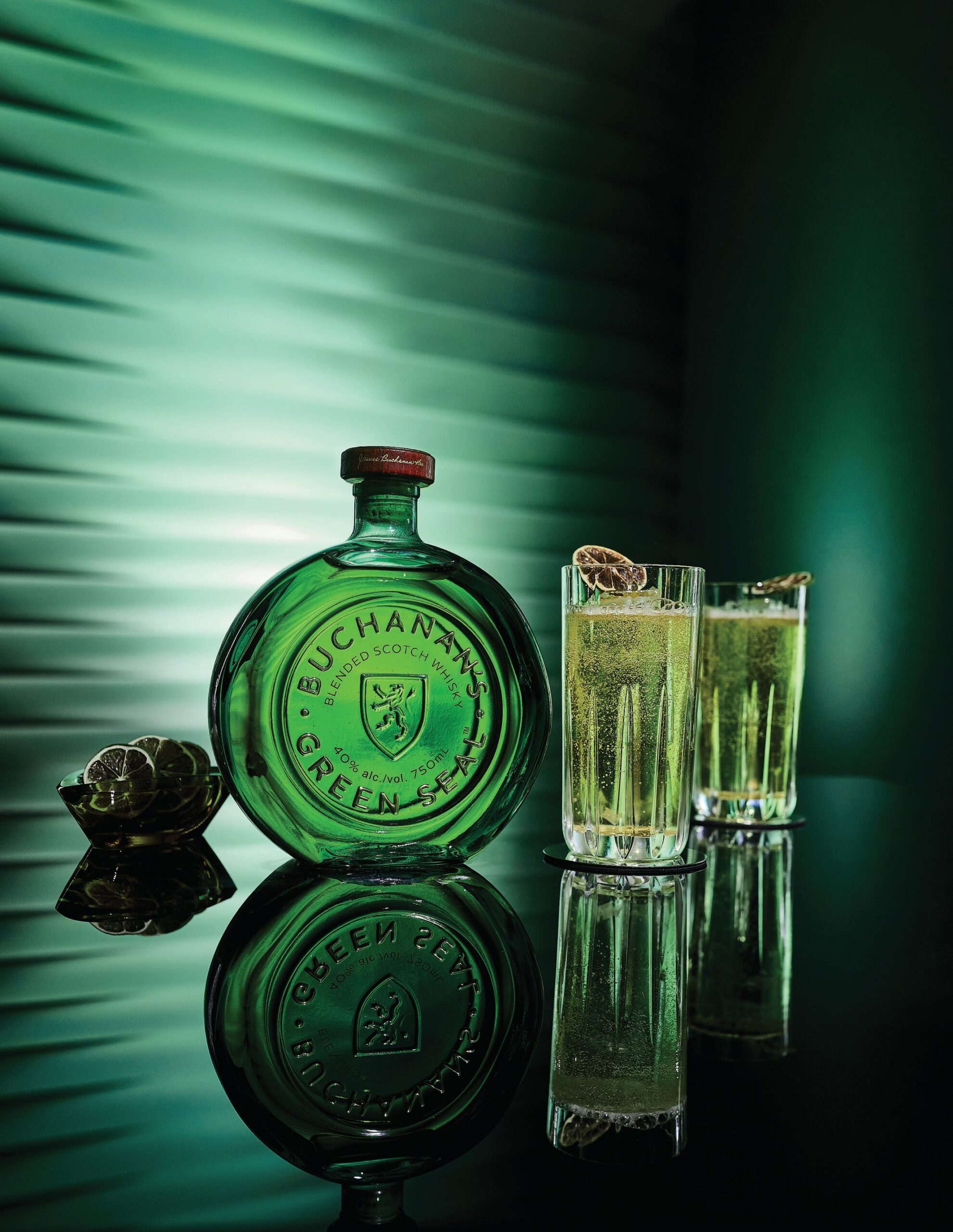
The bottle tells the same story. The familiar Buchanan’s silhouette remains, but the glass is a vivid emerald green that catches light like a nightclub exit sign. The circular gold on the front, from which the expression draws its name, feels like both continuity and wink: a heritage crest repurposed for a new inner circle.
Green Seal doesn’t pretend to be a clean break from the past. Instead, it reads like a recalibration: What if we made a whisky expressly for the way you’re already drinking us?
Naming What Was Already True: The 200% Generation
By the time Green Seal arrived, Buchanan’s had finally started saying out loud what its most loyal drinkers had been living for years.
The brand’s “We Are the Spirit of the 200%” platform doesn’t treat Hispanic consumers as half-and-half hybrids. It frames them as 100% Hispanic and 100% American—people who grew up translating for their parents, toggling between arroz con leche and Pop-Tarts, between Univision and Netflix, between accents depending on which room they walk into.
In campaign films and out-of-home, the brand has showcased 200%ers like Marcello Hernández, the Cuban-Dominican comedian from Miami whose stand-up lives in that dizzy space between immigrant family logic and mainstream recognition; chefs building menus that taste like two countries at once; creative collectives like Kids of Immigrants, whose clothes and visuals tell stories of migration, work and joy. Related note: We previously collaborated with Chef JJ Johnson (half Puerto Rican) during a Noche Buena family meal program in 2023. (Instagram: @chefjjjohnson)
The message is simple: your identity is not a glitch. It’s paramount.
Green Seal is the liquid expression of that message. It carries the Scottish crest, the old-world font, the history. It also carries tropical brightness, collaborative energy, and a flavor profile clearly designed for nights where the guest list, the playlist and the menu all speak multiple languages without asking permission.
Buchanan’s didn’t just leave Parliament for Latin America—it moved into our living rooms, learned our language, and became a quiet witness to every toast we never quite had the words for.
The Fund Behind the Toast
Legacy, especially now, is measured by more than bottle age statements. It shows up in where the money goes. In the communities that it seeks to celebrate.
To turn its 200% language into something less hypothetical, Buchanan’s created the 200% Futuro Fund, a donor-advised fund committing $1 million over five years to organizations serving Hispanic communities across the U.S.
Under that umbrella are programs that look very different from glossy bottle-shots:
Family Meal Giveback has partnered with groups like No Us Without You in Los Angeles and Street Vendor Project in New York to help provide meals, grocery support and relief to back-of-house workers, street vendors and service-industry staff—the people who make other people’s celebrations possible, often at the expense of their own.
Más Noches Buenas, a holiday effort, pledged significant support to nonprofits backing restaurant and bar workers around the country, making it possible for some of them to host their own Noche Buena dinners instead of just working through everyone else’s.
When he raises a glass that night, it isn’t just to the bottle on the table. It’s to the fact that, for once, the person serving the food is allowed to sit down and eat.
For a brand that has built so much of its reputation on being present at our best nights, this is what a modern legacy move looks like: not just leveraging culture, but reinvesting in the people who create it.
More Than One Face: The 200% Cast
Buchanan’s is honored to be part of Hispanic celebrations, no matter how people choose to celebrate—Buchanan’s brings the ritmo.
If Green Seal is the newest character in this story, it’s not the only one.
Beyond Rauw Alejandro’s high-gloss collaboration, Buchanan’s 200% campaigns have included a rotating cast of creators whose lives mirror the product’s dual roots: first-gen comedians, community organizers, chefs whose food tastes like two passports at once, fashion designers stitching migration and memory into streetwear.
Lucía, watching those spots on her phone between shifts, recognized pieces of her own life—a parent correcting her Spanish one minute and asking her to translate a contract the next; the decision to put pronouns in her bio while her mother still called everyone “mijo”; the way a single song could make a roomful of people from different countries shout the same lyrics.
When a brand this old chooses to center that mosaic of experiences, it’s doing more than chasing demographics. It’s admitting that the people it once considered “new markets” are now part of its DNA.
The 200% Room
Picture the space Green Seal is really built for.
It might be Lucía’s current apartment in Houston: a two-bedroom that hosts more people than its square footage should allow. It might be a house in Inglewood, a walk-up in Washington Heights, a rental in Orlando. There are plants in the corner, shoes piled near the door, a soft hum of video calls from earlier that day still echoing in the Wi-Fi.
The table is crowded: a pot of arroz, a tray of wings, Tupperware full of someone’s tía’s famous salad, store-bought dessert someone pretended to make, multiple hot sauces, a bowl of limes, and a green-and-gold bottle that looks like it belongs in every photo.
The room speaks in loops: “¿Te acuerdas cuando…?” bleeds into “Remember that time…?” and back again. Rauw plays, then Bad Bunny, then a ballad your parents slow-danced to in another decade. Someone pours Green Seal neat. Someone else adds ice. A third tops theirs with coconut water because they tried it once in Puerto Rico and now swears by it.
At some point, a story comes out that no one has heard before. At some point, someone says “I love you” under the cover of laughter. At some point, the room goes quiet in that soft, rare way that means everyone feels lucky to be there.
This is the room where Buchanan’s lives now. Not in Parliament, not in tasting rooms, but in the overlapping Venn diagram of immigrant history, contemporary hustle and chosen family.
Legacy, Reframed
James Buchanan built his name on the idea that if you could place your whisky in the right rooms—Parliament, royal households—you could change who took it seriously. That gamble paid off. The brand he created in 1884 is still here, recognizable on shelves around the world, its crest a shorthand for continuity.
But the more interesting legacy, the one that matters now, was written far from Westminster. It was written in Bogotá and Monterrey, in Queens and South Gate, in all the spaces where that bottle stood guard over toasts that had nothing to do with empire and everything to do with survival, joy and stubborn hope.
Green Seal is the latest chapter in that longer, messier story—a Scotch built not for the rooms that minted James Buchanan, but for the rooms that adopted him.
If legacy used to mean how long you’d been in the picture, now it means how truthfully you show up in the lives of the people who are still taking those pictures—and what you give back to them in return.
For Buchanan’s, that looks like this: a 200% platform that finally speaks the language of its drinkers; a fund that wires money into the communities that kept the brand alive; a new expression that tastes like tropical fruit and oak and late nights and laughter and something you can’t quite name but have always felt.
For Lucía, it looks like the same bottle from her childhood console, now in her own home, poured for a circle of friends who understand what it means to be too much for neat fractions.
From Parliament to the party, the bottle has traveled a long way. The legacy, it turns out, isn’t just in where it started. It’s in where it chose to stay.
Creative Credits
- Written by
- Alexandra Evans
- Senior Editor
- Emily Chu
- Images courtesy of
- Buchanan’s Whisky