For the first time since “The Macarena'” filled the airways, a Spanish song has reached the top of music charts worldwide (McIntyre 2017). In the same reggaeton music genre as Luis Fonsi and Daddy Yankee’s “Despacito” there's a new urban beat making the rounds. “Mi Gente”, translated to “My People”, is the recent collaboration of Colombian based J. Balvin and French DJ Willy William. Billboard (2017) notes that the song samples the baseline sound from William's "Voodoo Song",
“fusing African, electronic and Caribbean sensibilities…creating a new reggaeton sound altogether.” According to Latino Voices (6/30/2017) this hit has high ambitions and works to erase "barriers of races, colors, continents, genres or languages” through its lyrics and rhythm. A closer examination of the history of reggaeton and the “Mi Gente” music video reveals how stories and symbols adapt and change to meet the needs of new borders and populations.
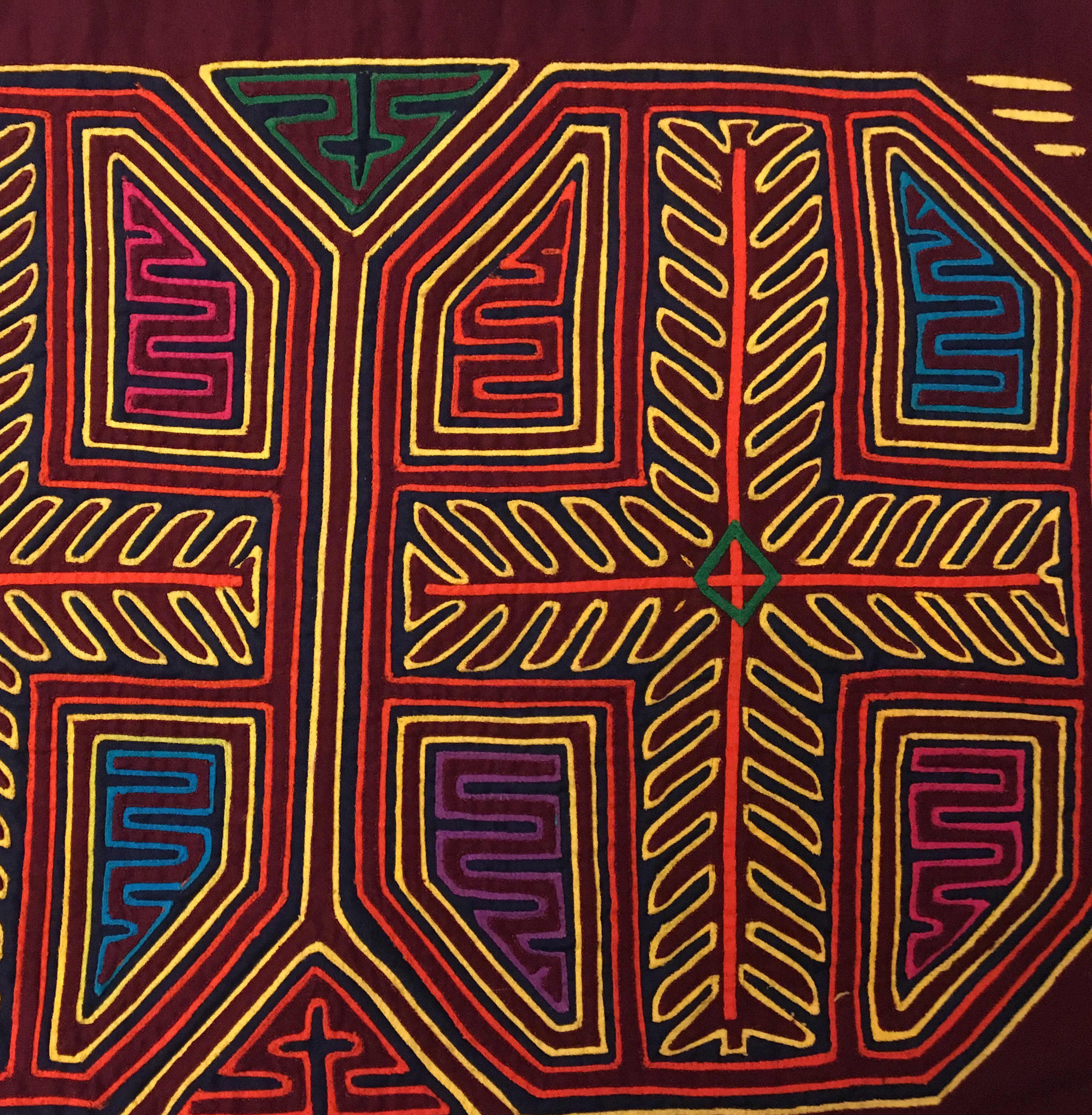
To get right into it, the “Mi Gente” music video shows off drawings of trendy geometric designs which act as morphing backdrops to the spotlighted reggaeton dancers. These indigenous drawings are called “Molas” and they belong to the Kuna people, a population spanning both the countries of Panama and Colombia. Unlike the country border which separates these two countries, the Kuna people are united by common customs and traditions which go beyond physical territory lines. Related to this, Arecio Valiente, an indigenous intellectual property rights specialist, points out that Panama Law Number 20 of June 26th, 2000 is limited in protecting the collective intellectual property rights of the Kuna community, as it only covers videos or movies produced inside the Panamanian territory (Zorrilla 11/7/17). This means producers like the “Mi Gente” production team who work in Miami, Florida, and Medellin, Colombia are exempt from paying tribute for the use of Molas in a music video. However, there was nothing stopping film teams in offering a courtesy gift to the General Kuna Congress, as carried out by "The Interpreter" production crew which gave a $1,500 donation for their one second clip displaying a gigantic Mola at the entrance of the United Nations.
Apart from the discussion of whether or not the General Kuna Congress should receive some sort of monetary contribution for the use of Molas in the "Mi Gente" music video, there are the topics of pride and visibility. It is thanks to this music video that a larger audience will be introduced to Mola patterns. However, the “Mi Gente” music video brands the Molas and the Kuna community to reggaeton, a music genre with origins in Puerto Rico and Panama, both of which have struggles of their own in relation to gaining acceptance by Latin audiences. During its conception, Rivera-Rideau explains that;
“The communities that were associated with reggaeton culture were also communities that were stigmatized. In Puerto Rico they were targets of anti-crime initiatives in the mid-1990s that represented them as chaotic, perpetrators of violence, tied to drugs and all kinds of stereotypes”. Reggaeton has its roots in being a community driven response to living life in “predominantly black, working-class communities”.
Yankee (2010) reports that the characters and stories which were originally placed in these songs acted as “neighborhood mirrors” for many Latin American communities, offering the time and space for individuals to reclaim complex realities often tied either directly or indirectly to drug trafficking, poverty, and violence. In many South American countries there is a strong divide between those who identify with reggaeton as a genre and those who disregard it all together. The struggles and triumphs found in these songs reflect a particular sector of the Latin American population. They work to reaffirm the existence of human aspirations in spite of government policies and negative popular associations. And it is this same reggaeton voice, found in the “Mi Gente” music video which, according to HURTADO (2017), is reaching out to another specific community, the Kuna people, by the use of Molas and "the power of crossover culture". When collaborating artists J. Balvin and Willy William decided to include Molas as a backdrop in the “Mi Gente” music video, they essentially decided to merge reggaeton with Kuna cosmology, a traditionally urban beat mixed to a worldview circling around nature and duality.
Originally, Mola patterns were tattoos painted on the bodies of Kuna women. In the mid-18th century the Spanish introduced cloth to the Americas, and the Kuna women began transferring their designs to this material. “Mi Gente” represents a new transfer, a new medium of showcasing these colorful patterns in today’s modern age. Having made their way from bodies to blouses, and from panels to videos we must ask ourselves what is the grounding philosophy keeping these designs relevant? In tune with Kuna philosophy, two Mola panels:
“…should look very much alike and differ only in small details of design and color”
“…they should be inspired by nature, animals, fish, flowers, and daily life”
“…they should be the same, but different.”
How are we the same, but different? In a world that is constantly hyping, mixing, and mashing the new with the old and the slow with the fast, histories and faces are often erased. Forgotten are the Kuna people in the “Mi Gente” music video.
Absent from any screen shots, the Mola patterns have been effectively disconnected from their people. The Nature of Cities states that at a time when “the majority of indigenous peoples all over the world now live in urban settings”, the music video’s attempt to combine Molas with an infused urban beat falls short of its mission of “not discriminating against anyone”. How can we reflect on our similarities and differences, that is the contrasts which bring us together, if a part of us is not even present? “Donde esta mi gente?” or “Where are my people?” is what J. Balvin asks in the song. This question is all the more relevant given the absence of any indigenous people from the “Mi Gente” music video.
What the video has decided to include, and what it has decided to leave out reflects the types of negotiations taking place between cities and indigenous communities all over the world.
“Limited socio-economic opportunities in the cities result in indigenous peoples’ exclusion from economic gains of the growing cities”. (Mercer 2017).
If the music video were a window into Colombia and the types of evolutions taking place at this time, it would capture the energy of Colombian artists and the excitement there as the general society begins reintegrating with displaced and ex guerrilla populations. Deciding to use the Molas in the video seems to be an effort at including the Kuna population and other marginalized groups as part of the Colombia’s political discussion. But the fact that there is no statement explicitly connecting these images to their community nor any representation of indigenous members leaves viewers on the fence. The indigenous artifacts of the world, created by centuries of thought will continue to stand as symbols for us to absorb uniting and inspiring us to do more. And as we do more, let us continue celebrating reggaeton’s success, let us continue celebrating the Kuna people, let us continue taking care of one another. Allow us to swallow our pride, and let us remember how similar our identities and experiences may differ, but like a Mola pattern, we are still the same.
As J.Balvin asks:
“Donde esta mi gente?”
For more information, visit: www.
Creative Credits
- Written by
- Andrew Carstens
- Image courtesy
- Mola Art and Craft LLC, Copyright@ Kuna Indigenous people of Panama photos reproduced for Felix