In his book Ellison, a classically trained musician, used the improvisational rhythms of jazz to create a new vocabulary addressing racism. His “Invisible Man” is admitted to an elite black college cruelly overseen by Dr. Bledsoe. To the students the college offers the promise of cultural advancement. They are facing a hostile world for which Bledsoe pretends to prepare them. Instead he maintains his own power by keeping his wards in the dark about the fact that the education they purchase so dearly will not make them visible in the world. Also unseen by the students is the price Bledsoe himself pays for his power in the shuffling required of him by his own white board of directors.
Following a direct order from Dr.Bledsoe, the Invisible Man is told to escort a white board member around the campus which is Bledsoe’s perfectly groomed faux depiction of black life. During the drive the white board member demands the young man take him beyond the campus to see the real black world. The board member is hurt in a melee that develops because of the white man’s presence. For violating Bledsoe’s orders the young man is ordered to appear for punishment.
As a demonstration to the other students of Bledsoe’s complete control over their future, the Invisible Man is expelled from the college on the brink of his graduation. As a parting gift Bledsoe provides the young man with seven letters of recommendation to white businessmen. What seems to the young man a generous gesture, turn out to have instead, in a shocking sequence, vivid instructions not to hire the young man.
When the student ultimately finds work in a paint manufacturing plant, he is grievously injured in accident. His invisibility is revealed to him when he emerges from forced electroshock therapy to hear the doctors discussing his possible castration. Although he escapes castration, he has no union protection and no job. The only way he can accept the small compensation offered by management is to indemnify the corporation of all responsibility.
In his search for work, he encounters the Brotherhood, a quasi-communist organization which appears to encourage a better life for blacks. The oratorical gifts the young man employs on behalf of beleaguered blacks brings him a moment of visibility. This moment is quickly stolen from him when he is told that gifts like his were only intended to achieve the agenda of the group. They were not meant to provide assistance to benefit any single individual.
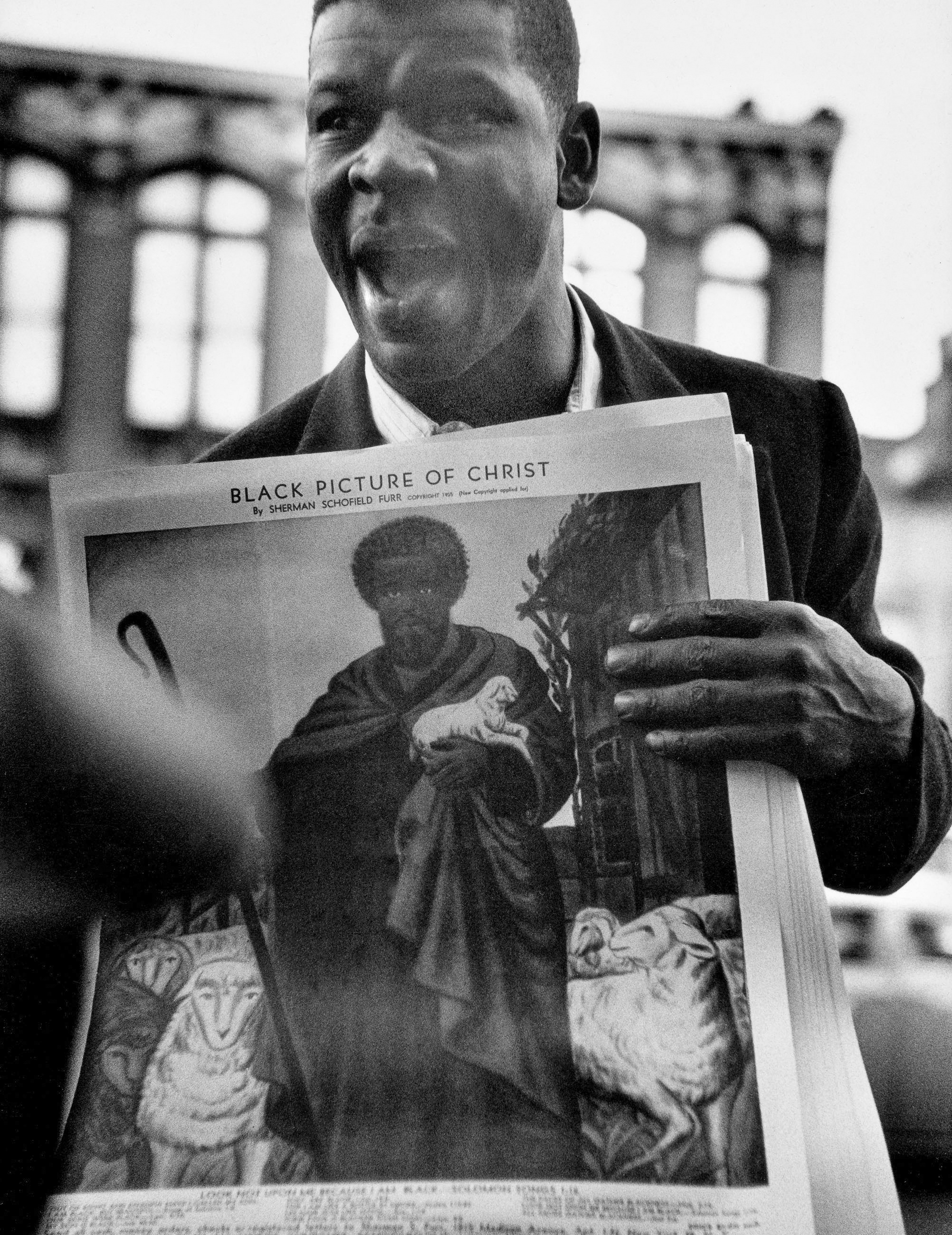
Fleetingly, he is drawn to a black religious group. The honest rage they express so freely seems at first to offer a bit of visibility. Ironically the group is run by Ras the Destroyer whose rage against everyone who hurts him or his followers turns homicidal. Recognizing these deaths as the ultimate invisibility, the Invisible Man flees from the rage of Ras. He escapes when he tumbles through a broken sidewalk into an abandoned room in a Harlem building which rents to whites only.
It is here the Invisible Man utters the following famous lines:
“Without light, I am not only invisible but formless as well, and to be unaware of one’s form is to live a death. I myself, after existing some twenty years, did not become alive until I discovered my invisibility.”
Ingeniously he ends his invisibility by stringing together 1,369 light bulbs across the abandoned room’s ceiling:
“I have been using the service of the Monopolized Light and Power for some time now. I use their service and pay them nothing at all, and they don’t know it. All they know is that according to the master meter back there in their power station a hell of a lot of free current is disappearing somewhere into the jungle of Harlem.”
Ellison was certainly aware anyone can be rendered invisible in a post-modern world, but was specifically telling African Americans to illuminate the their own identities and value by siphoning off cultural, financial, and “electrical” current from the mainstream culture however they could it.
The nearest thing to the experiences the Invisible Man encountered with The Brotherhood and Dr. Bledsoe may be seen in the emergence of the Tea Party and Trump. Their appeal appears to be with largely white followers who feel they have been rendered invisible by political correctness and a system beyond their control. In an odd way, Bernie Sanders and the emerging Black Lives Matter are both drawing other, though disparate, “Invisibles”. Did the revolution Sanders called for sputter out in the votes his massive crowds failed to deliver? Is the shifting appeal of Black Lives Matter less in focus because the juggernaut of news and social media transforms its improvisational language into flat pronouncements? Have large numbers of Hillary supporters been rendered “invisible” because of her support from Wall Street and her party’s endorsement of the TPP? What of the millions of former employees, now regarded as Independent Contractors? Their rights have been made invisible in the shadow of the corporation’s rights. What about all the “Have-nots” rendered invisible by the oh so comfortable “Haves”? Even England’s Brexit vote can be understood as the wail of that country’s “Invisibles”.
Reading Ellison today with our fresh awareness of these mass numbers of “Invisibles” leads us to very serious questions. What would happen if these Invisibles take a cue from the light bulbs the Invisible Man strung together? What if they were able to string together their votes in a tsunami of an election? Would that election illuminate fruitful, dynamic change or only deepen the political darkness in which so very many are already invisible?
Images Provided Courtesy of the Art Institute of Chicago & the Gordon Parks Foundation. Stop by the Art Institute of Chicago this month to see their current exhibit: Invisible Man: Gordon Parks & Ralph Ellison in Harlem, that explores the little-known collaboration of Parks and Ellison, reuniting the never-before-seen photographs and unpublished manuscripts intended for two projects.
Creative Credits
- Written by
- Leonora Francesca Flores
- Written by
- Elaine Madsen
- Photography
- Gordon Parks
- Image courtesy
- Art Institute of Chicago and The Gordon Parks Foundation