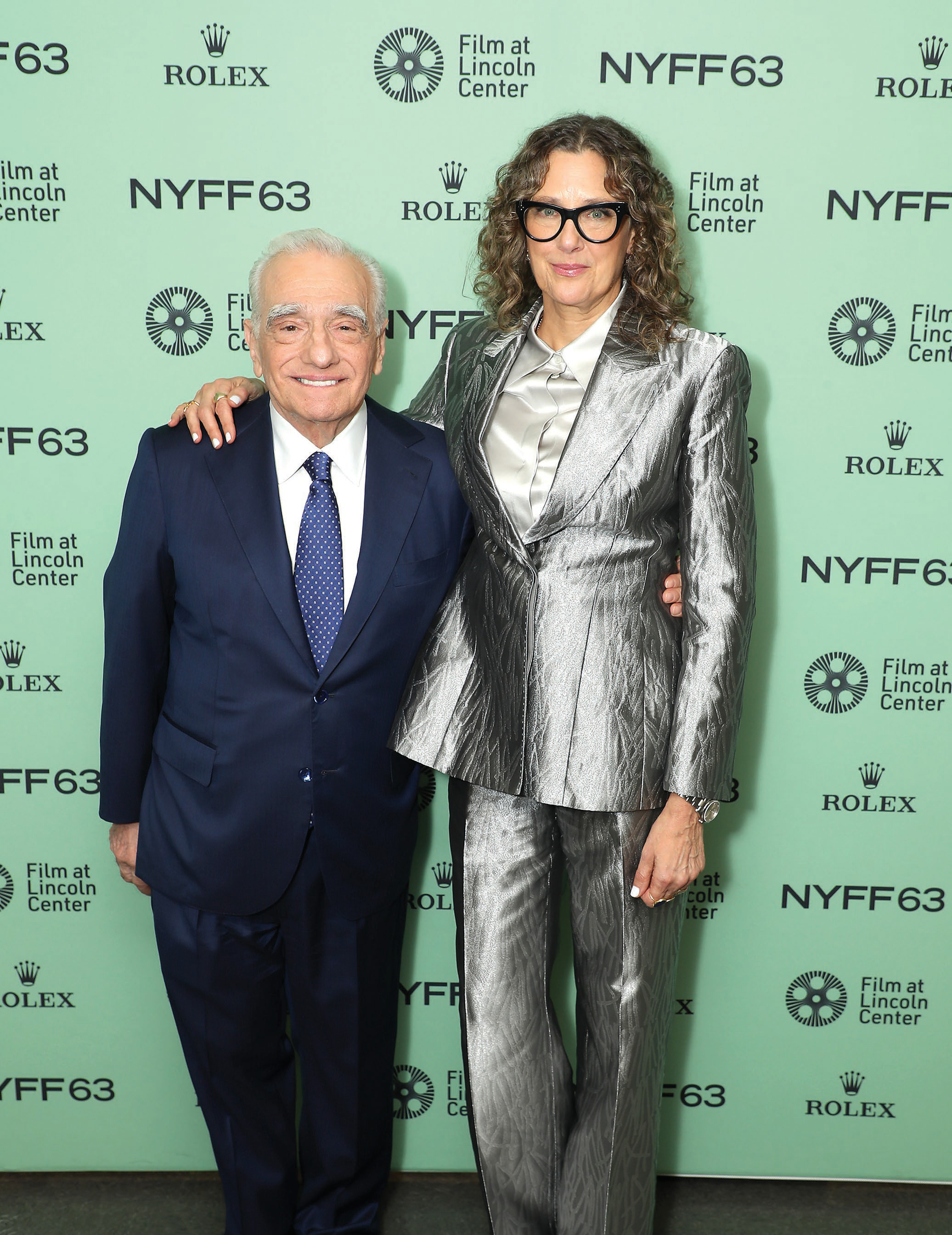
Martin Scorsese and Rebecca Miller (Director) – Photography by Marion Curtis / StarPix for Apple TV+.
On an early-October night in New York, the plaza outside Lincoln Center shimmered beneath the city’s perpetual glow. Inside Alice Tully Hall, cameras pulsed, velvet ropes parted, and conversation settled into the low, electric murmur that precedes an event people will remember. The New York Film Festival had chosen its Spotlight Section carefully: the world premiere of Mr. Scorsese, Apple TV+’s five-part documentary event directed by Rebecca Miller. The subject needed no introduction. Martin Scorsese—New York’s restless son, cinema’s moral philosopher—had come home to see his own life projected back at him.
The room filled with collaborators and confidants: Robert De Niro, Daniel Day-Lewis and his family, Josh Safdie, Jay Cocks, Nick Pileggi, Irwin Winkler, Mark Harris, Ellen Lewis. Around them, hundreds of filmgoers took their seats in reverent hush. When the lights fell, it was less a screening than a vigil for half a century of moving images.
Miller introduced the evening herself. “Thank you Dennis Lim and the New York Film Festival committee for having the vision to show all these episodes in a single portrait,” she said, voice steady but luminous. “It’s my dream come true… and most of all, thank you, Marty, for your honesty and your trust. It was one of the great privileges of my life.” The applause was immediate and affectionate—New York recognizing one of its own through another artist’s eyes.
A portrait, not a monument
What unfolded over the next five hours felt less like biography than conversation. Mr. Scorsese is Miller’s sustained dialogue with her subject, filmed across five years with unrestricted access to his archives. The series traces his evolution from NYU film student to cinematic icon, from Mean Streets through Killers of the Flower Moon. Rather than a chronological climb, Miller arranges the material like a fugue—themes of faith, guilt, and redemption returning in new keys.
Her camera is patient. It listens as Scorsese weighs the contradictions that have always animated his work: the tension between violence and compassion, devotion and doubt, art and sin. The filmmaker’s voice— quick, amused, occasionally trembling—anchors every episode. Interwoven are conversations with those who have built worlds with him: De Niro and Day-Lewis, Leonardo DiCaprio, Thelma Schoonmaker, Steven Spielberg, Sharon Stone, Jodie Foster, Paul Schrader, Mick Jagger, Margot Robbie, Cate Blanchett, and dozens more. Their recollections map an artistic conscience that has never stopped questioning itself.
For Miller, who previously chronicled her father in Arthur Miller: Writer, this project extends a lineage of portraiture rooted in intimacy. She resists hagiography. The documentary lingers on quiet details—hands sorting through reels, a pause before confession, the half-smile of someone surprised by his own memory. Even amid celebrity cameos, the tone remains personal, almost domestic. Viewers sense they are watching a conversation still in progress rather than a legacy locked in glass.
A celebration and a reckoning
When the final credits appeared, the audience rose instantly. De Niro clasped Scorsese’s shoulder; Rebecca Miller smiled through the ovation that filled the hall. It was gratitude rendered audible. Outside, under the marquee, the same faces who have populated Scorsese’s universe for decades—actors, editors, producers—mingled with students and first-time filmmakers. The night belonged to cinema itself. The documentary’s sweep is vast, yet its heart is modest: a man revisiting the obsessions that made him who he is. Raised in Little Italy by parents who measured life through church and neighborhood, Scorsese learned early that stories and salvation are twins. Miller captures that duality with warmth. Each episode returns to the idea that faith and film are both acts of editing—cutting away illusion to find truth. The result is an essay on creation as confession.
Apple TV+ and the new canon
For Apple TV+, Mr. Scorsese continues an ambitious documentary slate that has already produced STILL: A Michael J. Fox Movie, Selena Gomez: My Mind & Me, and STEVE! (martin)—projects that reimagine celebrity not as spectacle but as study. In that context, Scorsese’s portrait feels inevitable. Where STILL examined perseverance, and Selena Gomez explored vulnerability, Mr. Scorsese meditates on endurance— the grace of sustaining obsession without letting it devour you.
Rebecca Miller’s filmmaking shares Scorsese’s moral curiosity but replaces his velocity with stillness. She allows silence to do the editing. Through her, Apple TV+ positions its documentaries as emotional architecture: spaces where icons are neither embalmed nor exposed, only understood.
The company he keeps
Part of the film’s charm lies in its chorus of witnesses. De Niro, stoic as ever, recalls the wordless trust that shaped Taxi Driver and Raging Bull. Day-Lewis describes Scorsese’s sets as “monasteries of focus.” Schoonmaker speaks of their half-century partnership as “a marriage built on rhythm.” These moments ground the myth in labor: the grind of editing bays, the fragile faith that each film might redeem the last.
Miller also opens the archive beyond Hollywood. Family photographs, early NYU footage, and notes scrawled beside storyboards trace a man perpetually caught between guilt and gratitude. The series observes his late-career serenity without pretending he has found peace. “You never stop wrestling with the picture,” he says in one segment. “You just hope it teaches you something before it’s done.”
Apple TV+. (2025, October). Apple TV+ celebrates the world premiere of the five-part documentary event “Mr. Scorsese” at the New York Film Festival. MediaMAX Press Release. Glendale, CA: MediaMAX. Film at Lincoln Center. (2025). Spotlight Section: Mr. Scorsese – New York Film Festival Program Notes. New York, NY: Film at Lincoln Center. Apple Original Films. (2023–2025). Documentary Slate Press Materials: STILL: A Michael J. Fox Movie; Selena Gomez: My Mind & Me; STEVE! (martin). Cupertino, CA: Apple Inc.
The festival as confessional
Within the New York Film Festival’s storied timeline, this premiere felt especially resonant. Scorsese first appeared at NYFF more than fifty years ago with Mean Streets; returning now as subject rather than auteur closed a cinematic circle. Festival director Dennis Lim called the screening “a portrait of artistic life as spiritual quest.” The description fits. For attendees, the evening was a communal reckoning with what cinema can still mean in an age of scrolling.
At the post-screening reception, conversation drifted from technique to tenderness. De Niro greeted old collaborators quietly; Daniel Day-Lewis and his sons moved through the crowd with understated grace. Guests remarked that Miller’s film achieved something rare—it humanized genius without diminishing it. One young critic summed it up neatly: “It’s a master class that feels like a confession booth.”
Between faith and frame
What keeps Mr. Scorsese from sentimentality is its candor. Miller doesn’t shy from the contradictions that haunt her subject: a devout Catholic fascinated by sin, a meticulous craftsman addicted to risk, a historian of crime obsessed with mercy. The film honors those tensions as the source of his vitality. Each reel becomes a meditation on imperfection—how grace lives not in triumph but in persistence.
Scorsese, now eighty-two, speaks of mortality with the calm of someone still mid-scene. “We all want to believe there’s order in what we’ve made,” he says near the close. “Maybe the work is the order.” It’s a line that lands like prayer.
The closing image
As the crowd spilled onto Broadway, the festival’s lights refracted off wet pavement, turning the night itself into a Scorsese frame—neon, sacred, slightly dangerous. Behind the glass doors of Lincoln Center, technicians dismantled projectors, and the last applause faded into hum. The director of Goodfellas and Silence had become the subject of his own meditation on faith, and somehow it felt right.
In Rebecca Miller’s hands, Mr. Scorsese is not a summation but a continuation. It asks what remains when the camera stops, and answers softly: everything. For Félix, the documentary captures exactly what this cultural moment craves—art that refuses cynicism, memory rendered as grace. Watching Miller and Scorsese share that stage was to witness cinema’s oldest truth: that the frame may end, but the vision never does.
Creative Credits
- Written by
- Valentina Rowe
- Photography
- Marion Curtis / StarPix for Apple TV+