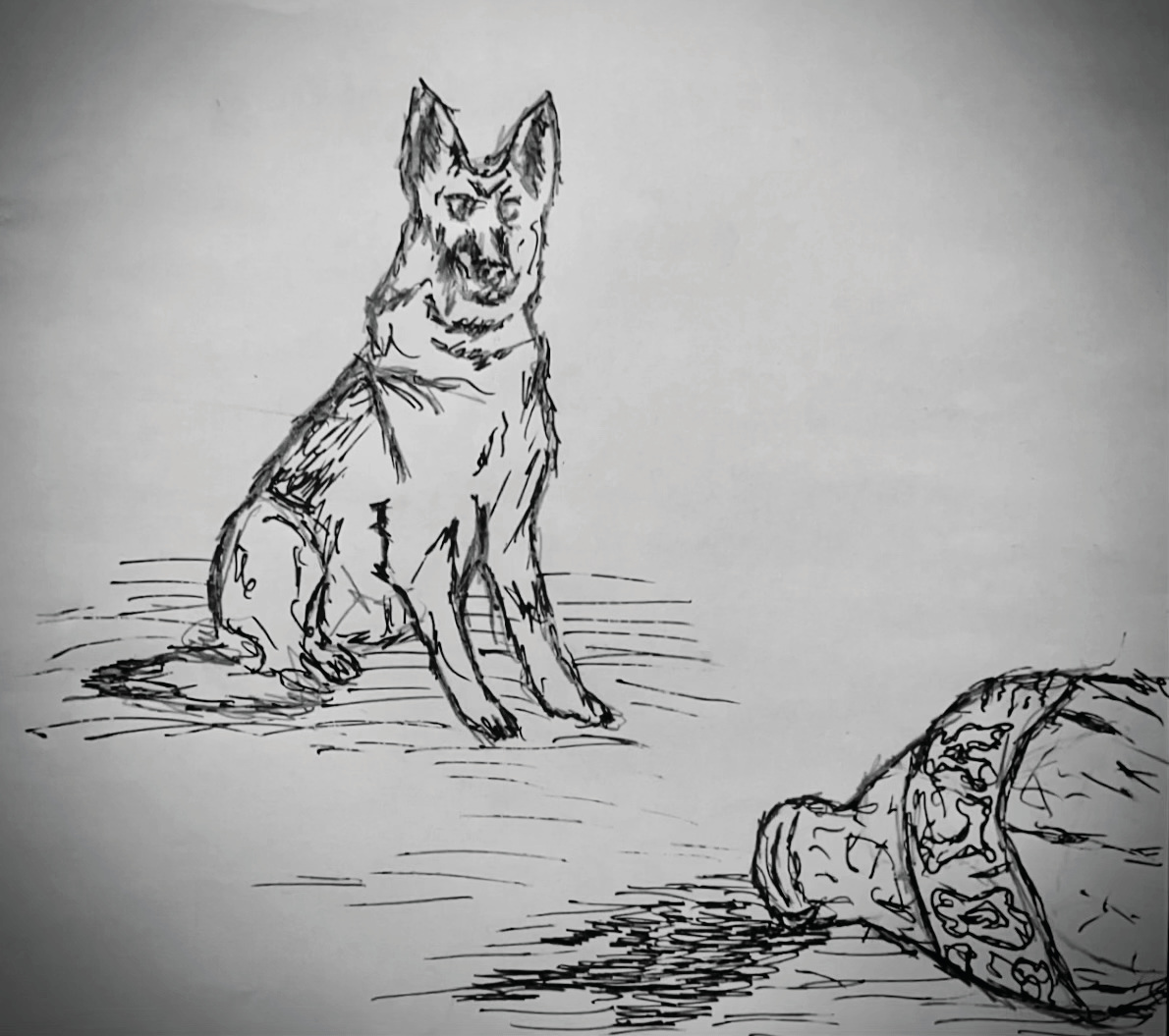
We knew the train tracks would lead us to traffic jams. Hopefully in some perfect circumstance where the train came to a stop on a busy road while everyone was evacuating. That has always been the best way to scavenge anything — you have to think pre-war. You have to remember how people moved back then, where they went, and what they may have taken with them. Francis found a Lugar in a retirement home. Now that’s thinking. Sure enough, we found a good string of civilian vehicles stopped by a train so long ago. “Hey, Sora. Look at this. These ones were all leaving the city, it looks like.” Francis said, stroking his white hair. “They must have soda, you know? Back then they picked it up at before the big drives. Betcha there are some pints or jugs even.” I followed the old man toward the cars as he began naming them as he often did. “Mercury. There’s a Mazda. Oh a Chevy. And that there… Looks like a Subaru, or.” “I’ll start with the front,” I said. Francis went on to the second car in the line as I came to the first and tried to door. Locked. I took my glass breaker and shattered the window with two clean hits while Francis pulled open his door straight away. I looked to the cup holder where an ancient paper cup sat waiting like a flower for a bee. I sat in the driver's seat and pulled the lid off the cup. Jackpot. It was a quarter full of goo, which is about the best you can expect. A full cup of soda will settle to this level. I took my goo jar and my scoop, scrapped out all the goo I could from the cup, and transferred it to my jar, which was already partially filled with my last score some weeks ago. I made sure to check the compartments and the truck before setting off for the third car in the line. “Anything?” Francis asked. “Oh ya. Got a full one back there. Nothing else though, just books and trash really.” Francis looked up at the sun hanging halfway across the sky. “Lets not take too long now,” he said. We gleaned all we could from the traffic jam and went off the way we had come, with the sun at our backs, raising tension as it fell. It wasn’t until after hours of walking that I became aware we hadn’t been speaking to one another. We only kept our eyes on one another and maintained a minimum separation. Regardless of my realization, I had nothing to say. I was comforted by the season. In this friendly time of year, we wouldn’t suffer the cold, even at night. We passed an old, overgrown gas station. A place reclaimed by nature and turned into a hallow hill whose cave entrances were draped in ivy, hiding its old use like a coral-coated steamship at the bottom of the sea. I saw a squirrel leave calmly through a shattered window and soon vanished into the understory that had slowly worked through the cement. I suppose it would have all been natural to me if it weren’t for Francis’s stories about maintained cities. Though erosion and reclamation had not spared his memory either. “Let’s get on.” He said, stopped, and turned to me. At one point, our path took us past an overgrown baseball diamond, where the chain-link fence lay collapsed and rusted. In the center of the field, a figure stood with a dog, the animal's tail wagging tentatively as it sniffed the air. The person, clad in layers of mismatched clothing, watched us with cautious interest, making no move to approach or flee. Francis raised a hand in a tentative greeting, but the figure merely nodded, turning back to their canine companion as if affirming our status as non-threats. We reached the last row of houses at nightfall. We went between them and looked over a grassy field at the tree line about a half mile off, within which was our home. Francis stopped me with a hand to my chest, and he took his bag from his shoulder and went about digging through it anxiously. “Whats up? Need something?” “You know what I need, asshole.” I didn’t, but then I did. He produced his bubble pipe and his soda goo jar. He took a teaspoon's worth of goo and carefully loaded his pipe, nearly dropping these precious things in his shaking. I handed him my torch lighter to save him the trouble of digging more and myself the trouble of watching. He smoked the goo eagerly, taking lungs fulls of syrup vapor, which left his body as clear as air. He became dumb, continuously nodding until some force took hold of him, and he rose to his feet like a droid. He went off quickly toward the woods, and I followed. The woods loomed ahead, a dark silhouette against the night sky, and as we approached, the familiar sense of unease that always accompanied our returns settled in. We navigated the familiar paths despite the darkness, our steps guided by the faint glow of the moon filtering through the canopy above. The sound of our footsteps mingled with the distant calls of nocturnal creatures, a reminder of the wildness that had reclaimed the world. It wasn't long before the outline of our makeshift shelter came into view, nestled among the trees, its camouflage blending seamlessly with the surrounding vegetation. Francis, still under the influence of the goo, showed no sign of slowing down as he approached the shelter. His earlier lucidity seemed a distant memory, replaced now by a singular focus on reaching our haven. I couldn't help but feel a twinge of pity, mixed with frustration, at his condition. As we reached the door of our shelter, Francis fumbled with the latch, his coordination impaired. I stepped forward, taking over to open the door, and as we entered, the familiar smell of damp earth and wood smoke greeted us. We spent the night in the safety of the woods, but come morning, our little camp was on our backs, and we were on the move to the nearest settlement, Campus City. We traveled across comfortable plains and foothills, navigating treacherous cities of decommission where walls crumbled, and asbestos, silica dust, and mold confront us like old enemies. Francis could barely keep up, caught not only by the physical challenge of urban navigation in this eroding artificial biome, but also by his bubbling memories. At a time, we came over a hill where a whole city skyline came into view. We both stopped in our tracks at the quiet beauty of it. Like a massive rock formation, it trapped us in awe, and I looked on, wondering about its history, and marveled at its existence. I thought of humans constructing it and living in it, and I began to feel alien. What were they, if not the same as me? Though what am I, here at the edge of the foothills? Francis broke our contemplation with a sigh. “Look at that. Like a big spiky bee hive,” he said about the city, shortly followed by “a dead hive I suppose.” I broke away from the city and looked to Francis, who looked on like it was a mirage. His eyes were glassy with tears. “You’ll never know it like I knew it,” he said to me, to which I had no response. He was right, I had never known a populated city. I only know these hellish blights that scar the eye and body, but hold valuable treasures like the goo or the Lugar. I knew it had to be me to break away from the sight and continue on, as Francis could become locked in such a trance. He would return to his old life, at least as closely as he could. The city, to him, would un-furl and rise to its great past. Phantom car horns and bright advertisements would bound across the landscape and zero in on him like the dying light of a star. And to shake him from this state was to crumble his illusion and wake him from a dream. “Let’s keep going,” I said. “It will be dark soon.” “Why dont we just set up around here. I can really use some rest,” Francis said, still staring at the dead hive. I was tired, too, but this was hardly a good place to stop. We were atop a hill, where the wind would torment us throughout the night, and any light source would be seen for miles around. “Are you sure?” I asked, “how about we set up down there?” I gestured to a small valley between our hill and another. It was flat and grassy, without bushes or trees where bugs and pests might hide. But when I looked at Francis, he was elbow-deep in his bags, rummaging for his pipe and goo. “Hey, slow down,” I said, putting a hand on his shoulder. He twitched hard, slipping his shoulder out from under my hand. Then he stopped his search and took a few deep breaths before pulling his hand from the bag. I knelt down beside him and began unloading my camping gear. After a quiet moment of unpacking, Francis spoke. “I’m getting a bit crazy, aren’t I.” I didn't know how to respond. It was true. Soda goo, among other post-collapse intoxicants, had its grip on a sad lot of the surviving communities. But what was more difficult for us was that we survived off the stuff by trading it and, in Francis’ case, by using it. Before I found a response, he continued. “I’m decaying. Like that gas station, remember? Like that hive.” I looked at the sky and saw that the sun was still a quarter away from the horizon. We had time to talk. “Because of the goo?” I asked as I set myself down beside him. “No. It’s not just the goo. The goo has been my only way out, recently. I can't stand the sight of these cities and their smell. They just crumble further to the ground each year. This has got to be my tenth time passing this skyline, and I swear there used to be a few more towers. But you know, I’m not really sure.” “It’s not a way out, it’s just a distraction.” “It’s more than that. It's my only escape sometimes.” “What do you mean?” “I just get so scared,” He said. “I can’t face this world — all this traveling through horrible places. The woods and foothills are no different — they are terrifying. I end up feeling like an abandoned child, and without the goo I would spend the nights crying and pacing the camp.” I saw Francis glancing up at his bag a few times, contemplating a second dig. “You’re addicted, Francis. It’s as simple as that. You know you can turn to the goo at any time to change your perception.” “Change my perception? That’s not a bad way of putting it.” “Maybe you can start weaning off. I can’t imagine what that vapor is doing to your lungs.” Francis scoffed. “It’s a discussion for another time, Sora. It’s not a bad idea, but we have to reach the next town.” “What about tonight? I could stay up with you.” “No, not tonight. I can’t.” “But you smoked every night for this whole trip. And you know, by the time we reach the next town we might not have much to trade with.” Francis took a deep, uneasy breath. "Not tonight, okay?" his voice edged with hostility, signaling that this trailside therapy session was over. “Fine. let’s set up camp first, please.” We carried our stuff down to the little valley and erected our tent. I was hammering the stakes into the ground when I saw Francis digging through his bags, preparing to obliterate his consciousness. I could only take my advice so far before I became hypocritical. After all, we collect and sell the goo to settlements in the region. Our biggest score always came from Suvin, a merchant in Campus City. It was our current destination, we would reach it the next day. Suvin sold the stuff to other traders and to the settlers living in Campus City. I heard the flick of a lighter and saw Francis drawing in a deep breath of goo vapor. The goo sizzled under the flame, much of it melting and hardening in the bowl piece of his water pipe. It was hard to watch, but it was tricky to argue against. As always happens, Franwent stoic like a robot — like a laser focus came over him. He glanced about as if he had awoken and needed to get his bearings. I sometimes wondered why he kept off the goo while he was on the trail because this focus could probably drive him across the region in a day. Though he always explained that it actually helped him sleep. He supposed, over a conversation some months ago, that it helped him focus only on sleeping and on what he called “the movies of my mind.” “Movies?” I asked.
Then, Francis taught me about the visual stories “projected” from machines at the press of a button. I knew about televisions but had not really wondered about what they actually displayed. Apparently, they played a selection of repeatable stories with varying effectiveness at capturing the focus of the person watching. People would click across the selection, across hundreds of “channels,” until a projection’s effect was so thrilling they had to stop. “So it’s like watching TV, I guess. I feel like I’m watching something rather than experiencing it. Does that make sense?” Between my inexperience with TV and goo smoking, I was at a loss. “Is it like a dream?” Francis smiled. “Yeah, that’s a better way to say it. I should have just started with that.” I remember feeling uneasy after that conversation. It was a common feeling that came over me whenever I looked over the amazing, incomprehensible city and considered the ancient past. The mystery alienates me, and I have to look toward the future instead. We arrived at Campus City by noon the next day. We took the long, straight road from Patterson exit down what a road sign called Freeway 217. It was a long, straight road that cut through a marshland. There was a great variety of birds; Francis tried to name a few. We made our deal with Suvin, but we weren't allowed to stay in town. He said that the security was onto us, and trying to curb the sale of soda goo in the city. This got Francis really worked up. “Where the hell am I going to sleep, then? I have been sleeping in the wilderness for weeks. I’m sick of it. Come on, Suvin. Don’t you have anywhere to stash me?” “No. I’m sorry, Francis. Your best best is probably the in those suburbs across the freeway. None of our patrols go out that far, and there are plenty of homes still standing.” At this point, Francis was huffing and puffing, but it couldn't be helped. Suvin stood behind the counter, watching Francis pull out his water pipe and load a glob of soda goo. “I don’t think that’s a good idea right now, Francis.” But Francis didn't listen, he drew in one of the largest hits I had seen yet. This time, the vapor flowed out of his mouth as a rather thick cloud, and halfway through the exhale, he had a coughing fit. He fell over the counter and held himself up until he was done coughing, and there was no more vapor draining from his mouth. Then he was up, alert as ever, clearly taken over by the goo once more. “Francis, you okay?” I said through the settling vapor. “You better get him out of here,” Suvin said, but Francis was already on his way out, leaving his bags behind. “Hey, wait!” I called out, but he rounded the corner outside Suvin’s shop. I took a minute to grab his bag and throw it over my shoulder, where it rested on top of my backpack. As I left, I saw Francis’s pipe left on the counter, Suvin was looking at it, too. Outside, I lost track of Francis. He had apparently bolted off in his usual way. It was the last time I ever saw him. At one point, our path took us past an overgrown baseball diamond, where the chain-link fence lay collapsed and rusted. In the center of the field, a figure stood with a dog, the animal's tail wagging tentatively as it sniffed the air. The person, clad in layers of mismatched clothing, watched us with cautious interest, making no move to approach or flee. Francis raised a hand in a tentative greeting, but the figure merely nodded, turning back to their canine companion as if affirming our status as non-threats. We reached the last row of houses at nightfall. We went between them and looked over a grassy field at the tree line about a half mile off, within which was our home. Francis stopped me with a hand to my chest, and he took his bag from his shoulder and went about digging through it anxiously. “Whats up? Need something?” “You know what I need, asshole.” I didn’t, but then I did. He produced his bubble pipe and his soda goo jar. He took a teaspoon's worth of goo and carefully loaded his pipe, nearly dropping these precious things in his shaking. I handed him my torch lighter to save him the trouble of digging more and myself the trouble of watching. He smoked the goo eagerly, taking lungs fulls of syrup vapor, which left his body as clear as air. He became dumb, continuously nodding until some force took hold of him, and he rose to his feet like a droid. He went off quickly toward the woods, and I followed. The woods loomed ahead, a dark silhouette against the night sky, and as we approached, the familiar sense of unease that always accompanied our returns settled in. We navigated the familiar paths despite the darkness, our steps guided by the faint glow of the moon filtering through the canopy above. The sound of our footsteps mingled with the distant calls of nocturnal creatures, a reminder of the wildness that had reclaimed the world. It wasn't long before the outline of our makeshift shelter came into view, nestled among the trees, its camouflage blending seamlessly with the surrounding vegetation. Francis, still under the influence of the goo, showed no sign of slowing down as he approached the shelter. His earlier lucidity seemed a distant memory, replaced now by a singular focus on reaching our haven. I couldn't help but feel a twinge of pity, mixed with frustration, at his condition. As we reached the door of our shelter, Francis fumbled with the latch, his coordination impaired. I stepped forward, taking over to open the door, and as we entered, the familiar smell of damp earth and wood smoke greeted us. We spent the night in the safety of the woods, but come morning, our little camp was on our backs, and we were on the move to the nearest settlement, Campus City. We traveled across comfortable plains and foothills, navigating treacherous cities of decommission where walls crumbled, and asbestos, silica dust, and mold confront us like old enemies. Francis could barely keep up, caught not only by the physical challenge of urban navigation in this eroding artificial biome, but also by his bubbling memories. At a time, we came over a hill where a whole city skyline came into view. We both stopped in our tracks at the quiet beauty of it. Like a massive rock formation, it trapped us in awe, and I looked on, wondering about its history, and marveled at its existence. I thought of humans constructing it and living in it, and I began to feel alien. What were they, if not the same as me? Though what am I, here at the edge of the foothills? Francis broke our contemplation with a sigh. “Look at that. Like a big spiky bee hive,” he said about the city, shortly followed by “a dead hive I suppose.” I broke away from the city and looked to Francis, who looked on like it was a mirage. His eyes were glassy with tears. “You’ll never know it like I knew it,” he said to me, to which I had no response. He was right, I had never known a populated city. I only know these hellish blights that scar the eye and body, but hold valuable treasures like the goo or the Lugar. I knew it had to be me to break away from the sight and continue on, as Francis could become locked in such a trance. He would return to his old life, at least as closely as he could. The city, to him, would un-furl and rise to its great past. Phantom car horns and bright advertisements would bound across the landscape and zero in on him like the dying light of a star. And to shake him from this state was to crumble his illusion and wake him from a dream. “Let’s keep going,” I said. “It will be dark soon.” “Why dont we just set up around here. I can really use some rest,” Francis said, still staring at the dead hive. I was tired, too, but this was hardly a good place to stop. We were atop a hill, where the wind would torment us throughout the night, and any light source would be seen for miles around. “Are you sure?” I asked, “how about we set up down there?” I gestured to a small valley between our hill and another. It was flat and grassy, without bushes or trees where bugs and pests might hide. But when I looked at Francis, he was elbow-deep in his bags, rummaging for his pipe and goo. “Hey, slow down,” I said, putting a hand on his shoulder. He twitched hard, slipping his shoulder out from under my hand. Then he stopped his search and took a few deep breaths before pulling his hand from the bag. I knelt down beside him and began unloading my camping gear. After a quiet moment of unpacking, Francis spoke. “I’m getting a bit crazy, aren’t I.” I didn't know how to respond. It was true. Soda goo, among other post-collapse intoxicants, had its grip on a sad lot of the surviving communities. But what was more difficult for us was that we survived off the stuff by trading it and, in Francis’ case, by using it. Before I found a response, he continued. “I’m decaying. Like that gas station, remember? Like that hive.” I looked at the sky and saw that the sun was still a quarter away from the horizon. We had time to talk. “Because of the goo?” I asked as I set myself down beside him. “No. It’s not just the goo. The goo has been my only way out, recently. I can't stand the sight of these cities and their smell. They just crumble further to the ground each year.
This has got to be my tenth time passing this skyline, and I swear there used to be a few more towers. But you know, I’m not really sure.” “It’s not a way out, it’s just a distraction.” “It’s more than that. It's my only escape sometimes.” “What do you mean?” “I just get so scared,” He said. “I can’t face this world — all this traveling through horrible places. The woods and foothills are no different — they are terrifying. I end up feeling like an abandoned child, and without the goo I would spend the nights crying and pacing the camp.” I saw Francis glancing up at his bag a few times, contemplating a second dig.
“You’re addicted, Francis. It’s as simple as that. You know you can turn to the goo at any time to change your perception.” “Change my perception? That’s not a bad way of putting it.” “Maybe you can start weaning off. I can’t imagine what that vapor is doing to your lungs.” Francis scoffed. “It’s a discussion for another time, Sora. It’s not a bad idea, but we have to reach the next town.” “What about tonight? I could stay up with you.” “No, not tonight. I can’t.” “But you smoked every night for this whole trip. And you know, by the time we reach the next town we might not have much to trade with.” Francis took a deep, uneasy breath. "Not tonight, okay?" his voice edged with hostility, signaling that this trailside therapy session was over. “Fine. let’s set up camp first, please.” We carried our stuff down to the little valley and erected our tent. I was hammering the stakes into the ground when I saw Francis digging through his bags, preparing to obliterate his consciousness. I could only take my advice so far before I became hypocritical. After all, we collect and sell the goo to settlements in the region. Our biggest score always came from Suvin, a merchant in Campus City. It was our current destination, we would reach it the next day. Suvin sold the stuff to other traders and to the settlers living in Campus City. I heard the flick of a lighter and saw Francis drawing in a deep breath of goo vapor. The goo sizzled under the flame, much of it melting and hardening in the bowl piece of his water pipe. It was hard to watch, but it was tricky to argue against. As always happens, Franwent stoic like a robot — like a laser focus came over him. He glanced about as if he had awoken and needed to get his bearings. I sometimes wondered why he kept off the goo while he was on the trail because this focus could probably drive him across the region in a day. Though he always explained that it actually helped him sleep. He supposed, over a conversation some months ago, that it helped him focus only on sleeping and on what he called “the movies of my mind.” “Movies?” I asked. Then, Francis taught me about the visual stories
“projected” from machines at the press of a button. I knew about televisions but had not really wondered about what they actually displayed. Apparently, they played a selection of repeatable stories with varying effectiveness at capturing the focus of the person watching. People would click across the selection, across hundreds of “channels,” until a projection’s effect was so thrilling they had to stop. “So it’s like watching TV, I guess. I feel like I’m watching something rather than experiencing it. Does that make sense?” Between my inexperience with TV and goo smoking, I was at a loss. “Is it like a dream?” Francis smiled. “Yeah, that’s a better way to say it. I should have just started with that.” I remember feeling uneasy after that conversation. It was a common feeling that came over me whenever I looked over the amazing, incomprehensible city and considered the ancient past. The mystery alienates me, and I have to look toward the future instead. We arrived at Campus City by noon the next day. We took the long, straight road from Patterson exit down what a road sign called Freeway 217. It was a long, straight road that cut through a marshland. There was a great variety of birds; Francis tried to name a few. We made our deal with Suvin, but we weren't allowed to stay in town. He said that the security was onto us, and trying to curb the sale of soda goo in the city. This got Francis really worked up. “Where the hell am I going to sleep, then? I have been sleeping in the wilderness for weeks. I’m sick of it. Come on, Suvin. Don’t you have anywhere to stash me?” “No. I’m sorry, Francis. Your best best is probably the in those suburbs across the freeway. None of our patrols go out that far, and there are plenty of homes still standing.” At this point, Francis was huffing and puffing, but it couldn't be helped. Suvin stood behind the counter, watching Francis pull out his water pipe and load a glob of soda goo. “I don’t think that’s a good idea right now, Francis.” But Francis didn't listen, he drew in one of the largest hits I had seen yet. This time, the vapor flowed out of his mouth as a rather thick cloud, and halfway through the exhale, he had a coughing fit. He fell over the counter and held himself up until he was done coughing, and there was no more vapor draining from his mouth. Then he was up, alert as ever, clearly taken over by the goo once more. “Francis, you okay?” I said through the settling vapor. “You better get him out of here,” Suvin said, but Francis was already on his way out, leaving his bags behind. “Hey, wait!” I called out, but he rounded the corner outside Suvin’s shop. I took a minute to grab his bag and throw it over my shoulder, where it rested on top of my backpack. As I left, I saw Francis’s pipe left on the counter, Suvin was looking at it, too. Outside, I lost track of Francis. He had apparently bolted off in his usual way. It was the last time I ever saw him.
Calvin Madsen, the author of short story "Soda Goo” appearing in this issue is a creative writer and journalist living in Pasadena, California. He is a graduate of UC Santa Barbara, and the author of “Hello Receiver” a book of short stories and also the founder of the literary arts magazine titled “Low Hanging Fruit”. Montana Artist Luke Madsen who illustrated the short story’ "Soda Goo' in this issue, specializes in everything from Harley choppers to sketchbook drawings. His favorite hobby is to turn those sketches into life, through classic muscle cars and motorcycles. He believes he was born with this passion, perhaps passed down from my father who carries many of these same traits.
Creative Credits
- Written by
- Calvin Madsen
- Illustrations
- Luke Madsen