
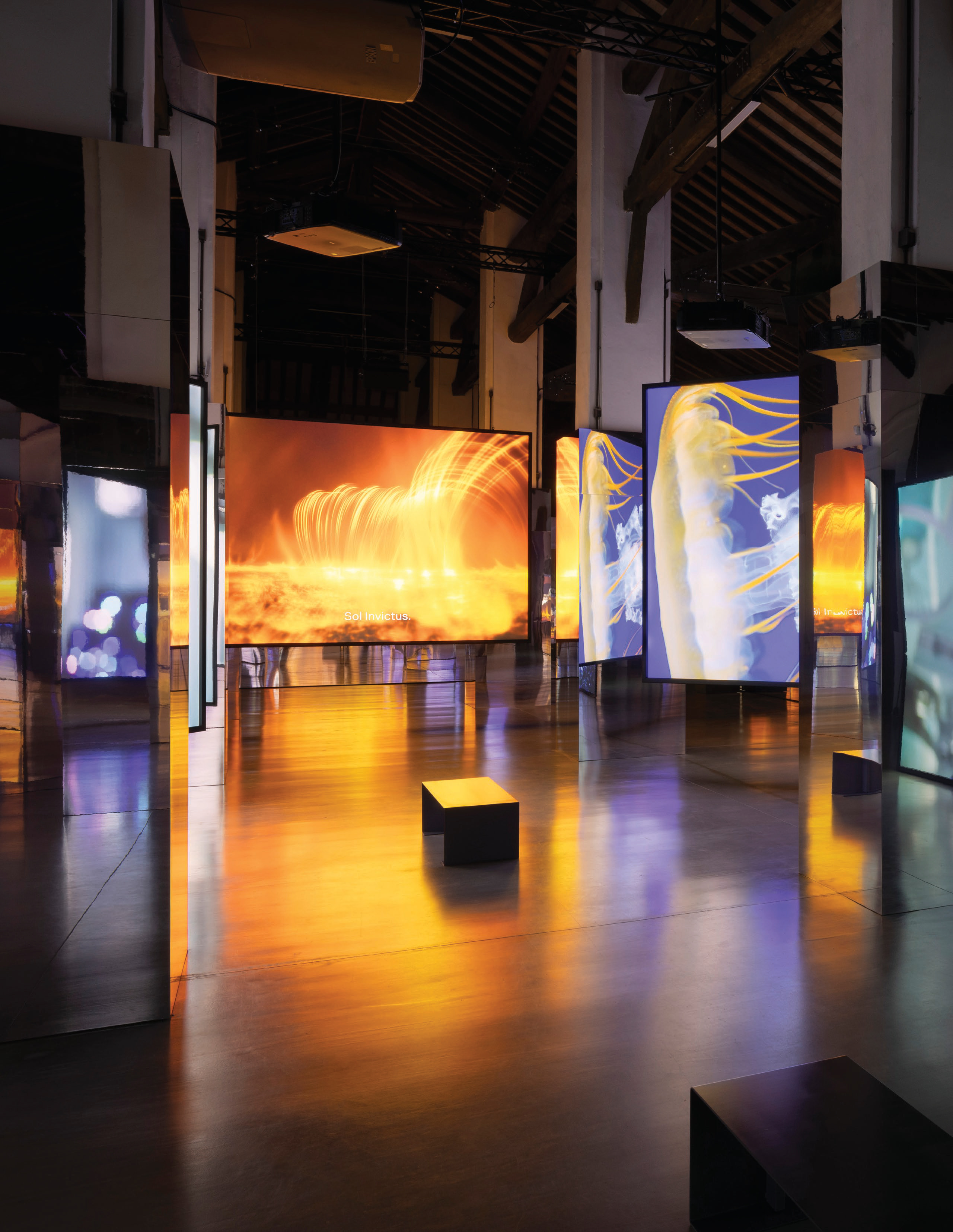
The light inside Palazzo Te falls as if time itself were a material—soft, mutable, alive. Frescoes ripple with myth and ruin, their pigments still breathing five centuries after Giulio Romano painted them for Federico II Gonzaga. Into this charged space—half palace, half hallucination— British artist and filmmaker Sir Isaac Julien has carried a new constellation of images: All That Changes You. Metamorphosis, a ten-screen installation that opens to the public in Mantua from October 4 2025 to February 1 2026. Curated by Lorenzo Giusti and commissioned for the 500th anniversary of Palazzo Te, the work transforms the palazzo’s restored Fruttiere halls into a cinematic organism of myth, science, and desire.
A Palace Reawakened
For five hundred years Palazzo Te has embodied excess and experimentation: a Renaissance dream of frescoes collapsing in on their own perspective. Julien uses that restlessness as a point of departure. Filmed within the Hall of the Giants and across rooms where Cupid and Psyche still orbit in painted dialogue, All That Changes You treats the palace not as backdrop but as co-author. Its walls become screens; its architecture, an actor.
“It’s an aesthetic, political, and mythological dream,” Julien says of the site, describing his intention to “subvert the visual hegemony dominating technological regimes of representation.” Shot on location in Mantua and across other architectural landmarks—the postmodern Cosmic House of Charles Jencks in London, Richard Found’s glass capsule in the English countryside, and Herzog & de Meuron’s media-art pavilion for the Kramlich Collection— his film traverses centuries as if they were rooms in one extended mansion. Each space has its own temperature of time.
The Figures Who Travel Time
Two actors anchor the work: Sheila Atim and Gwendoline Christie, who appear as otherworldly travellers—part goddess, part scientist, part memory of future life. Their dialogue is woven from voices that span literature and theory: Octavia E. Butler’s Parable of the Sower, Naomi Mitchison’s Memoirs of a Spacewoman, and Donna Haraway’s Staying with the Trouble. From Butler comes Lilith, a prophet of adaptation; from Mitchison, Naomi, a scientist who learns through empathy. Haraway’s ideas on symbiosis and “becoming-with” supply the ethical axis of the film: existence not as dominion, but as collaboration with all forms of life.
Their exchange is less narrative than choreography. As they move between Palazzo Te’s mythic rooms and the Redwood forests of California, identities shift, languages dissolve. In Julien’s hands, metamorphosis becomes not a story but a grammar. Images fold over each other; sound slides between screens; the viewer must navigate as participant rather than spectator.
Metamorphosis as Philosophy
The film’s title borrows its rhythm from Ovid but its conscience from contemporary science fiction. Julien and his long-time collaborator Mark Nash have crafted a script that melds mythology with ecology, asking what kind of future might emerge once the human ceases to be the center of the frame. The result is less didactic than devotional—a meditation on adaptation as empathy. In the installation, a ring of ten screens creates a polyphonic universe without hierarchy. Images of forest fires, alien landscapes, and the Palazzo’s own frescoed storms collide and regenerate. Donna Haraway appears at the opening, reading her reflection on the word “trouble” — “to make cloudy, to stir up, to disturb.” Her voice sets the tone for Julien’s visual manifesto: to embrace the unresolved as a place of care.
The Architecture of Time
Palazzo Te itself functions as a thinking body. Giulio Romano’s Hall of the Giants, painted with collapsing columns and falling Titans, becomes the epicenter of Julien’s cinema. Its ceiling’s apocalypse finds an echo in the film’s footage of burning landscapes; its circular room mirrors the film’s ten-screen structure. Other rooms —the Camera di Psiche, the Sala dei Cavalli—reappear as sites of reversal where feminine figures reclaim spaces once painted for masculine power. Architecture, here, is not container but collaborator.
Beyond Mantua, Julien extends his exploration of time through other architectures: Jencks’s Cosmic House (a postmodern map of the universe), Found’s glass capsule in the Cotswolds (a meditation on transparency and isolation), and the Herzog & de Meuron pavilion for the Kramlich Collection (a device that projects images into matter). Each structure marks a different epoch in human imagination—from Renaissance to Postmodern to Posthuman—and together they compose a visual genealogy of change.
The Poetics of Change
Julien’s camera has always moved like a poet’s sentence— circular, layered, refusing closure. In earlier works (Ten Thousand Waves, Lessons of the Hour), he wove memory and migration into cinematic frescoes. Here, he turns inward to cosmology itself. Metamorphosis becomes both subject and method: each edit transforms the viewer’s position, each screen offers a different orbit.
For Julien, form is ethics. The disruption of linear narrative mirrors the moral need to dismantle hierarchies between human and non-human, center and margin. The film’s grammar is polyphonic: images don’t illustrate arguments, they entangle them. By forcing the eye to choose, Julien asks the mind to share authority.
A Symphony of Voices
The dialogues between Lilith and Naomi are punctuated by quotations from Ursula K. Le Guin, Anna Tsing, and Carlo Rovelli—writers who approach science as storytelling and storytelling as ecology . Their presence underlines Julien’s commitment to collaboration across disciplines and species. In his hands, film is not a medium but an ecosystem of relationships: sound, image, architecture, thought. The installation thus embodies what Haraway calls “sympoiesis”—making with others. It is less a film to watch than a world to inhabit.
Metamorphosis and Grace
At its core, All That Changes You echoes the theme of this Félix issue: grace as the elegance of adaptation. Julien’s installation is neither apocalyptic nor utopian; it exists in the middle space Haraway calls “the thick present.” Its beauty lies in refusing finality. When Lilith whispers, “All that you touch you change, and all that you change changes you,” the phrase lands less as warning than as blessing. Change is no longer what we fear—it’s the measure of being alive.
When and Where to See It
All That Changes You. Metamorphosis premieres at Palazzo Te, Viale Te 13, Mantua, from October 4 2025 through February 1 2026. The exhibition is curated by Lorenzo Giusti as part of the palace’s 500th-anniversary celebrations, presented in the renovated Fruttiere halls. Produced by Palazzo Te with the support of the Rosenkranz Foundation, Canyon, Linda Pace Foundation, Jessica Silverman, Jack Weinbaum Family Foundation, the Mellon Fund, and the University of California, Santa Cruz, the project marks Julien’s first solo presentation in Italy since his Royal Academy knighthood.
Visitors can expect a multi-screen journey through Renaissance myth and futurist vision—an experience that feels less like viewing and more like becoming. Tickets and visitor information are available at www.
Creative Credits
- Written by
- Valentina Rowe
- Creative Credit
- Isaac Julien, Victoria Miro and Jessica Silverman