
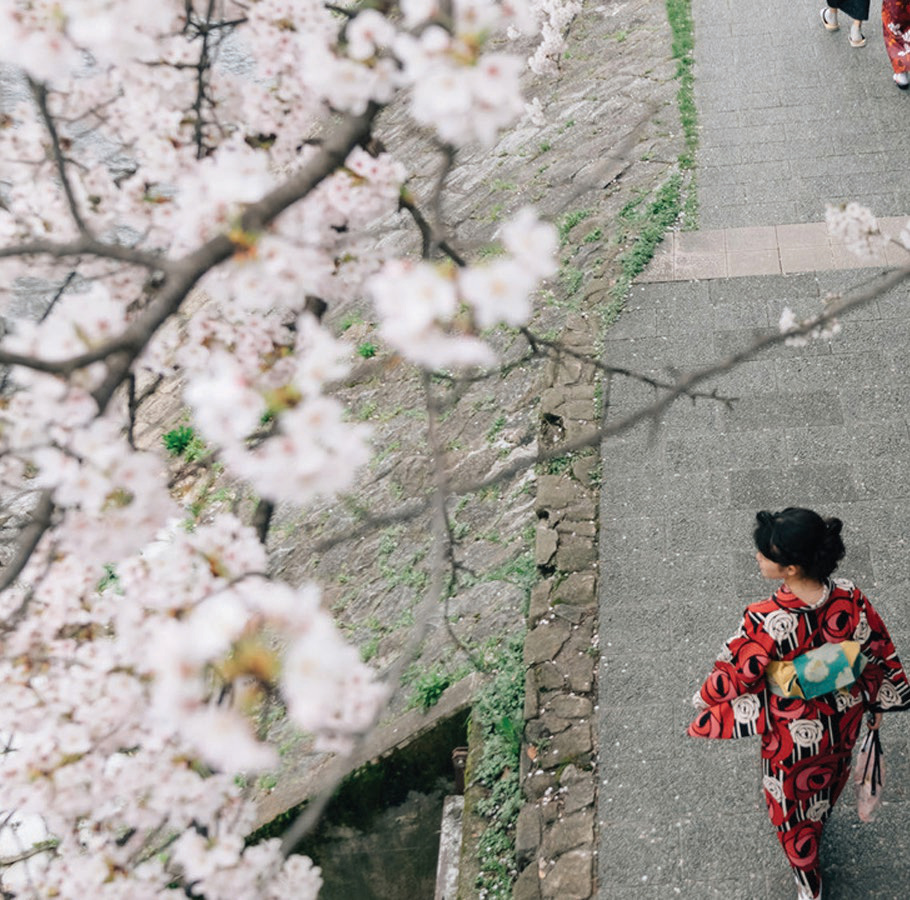
From Kyoto’s gardens of stillness to Megève’s alpine peaks and Seoul’s pulse of light, three Four Seasons destinations trace a single idea — that grace lives in contrast. Each place offers its own rhythm of refinement: one whispers, one glides, one hums. Together, they form a study in the art of presence — living beautifully, purposefully, and in motion.
Four Seasons Kyoto: The Geometry of Stillness
In Kyoto, stillness has architecture. The city moves at its own contemplative rhythm — a balance between past and present that can be felt as much as seen. At Four Seasons Kyoto, that rhythm becomes design.
Set within the historic district of Higashiyama, the hotel is anchored by an 800-year-old ikeniwa, or pond garden, where koi glide beneath maple leaves and reflections shift like calligraphy across water. The architecture follows Kyoto’s code of restraint: glass and wood arranged in quiet geometry, lines that guide the eye rather than command it. Inside, spaces flow like haiku — precise, spare, deliberate.
Every detail here feels meditative. Tatami textures, hinoki wood, and soft neutral tones invite silence rather than spectacle. Even the air seems to move differently, carrying the faint scent of cedar and tea. Guests speak softly, as if afraid to disturb the equilibrium. The hotel’s Tea House, Shakusui-tei, faces the pond and serves matcha with the ceremony and patience of a prayer.
Dining extends that sense of precision. At Sushi Wakon, Chef Rei Masuda shapes omakase like an act of mindfulness — each slice, brushstroke, and pause deliberate. It’s a rhythm that mirrors Kyoto itself: fleeting moments turned eternal by attention.
In a city that values impermanence as beauty, the Four Seasons Kyoto succeeds by honoring time, not defying it. The experience is not about escape, but alignment — the geometry of stillness rendered in light, texture, and breath.
Four Seasons Megève: Alpine Elegance at Altitude
High above the French Alps, grace has a different tempo. It’s not the silence of Kyoto, but the hush of snow — a purity that erases the line between landscape and design. The Four Seasons Megève, co-created with Edmond de Rothschild Heritage, sits within this expanse of whiteness like a poem in three dimensions: balanced, minimal, and impossibly calm.
Here, architecture becomes choreography. Angled roofs echo the peaks beyond; wood, slate, and glass compose an alpine palette both rustic and refined. The air carries a scent of pine and firewood, while inside, the flicker of light on timber walls gives the illusion of movement — like a heartbeat under frost.
The experience is shaped by contrast. The warmth of the spa, the sharpness of mountain air, the quiet discipline of skiing’s ritual — boot, breath, descent. At the hotel’s Le 1920, Chef Anne-Sophie Pic extends that duality to cuisine: modern French restraint lifted by alpine exuberance. Each dish feels sculpted, not plated.
What makes Megève exceptional is not its luxury — the Alps have no shortage of that — but its humility. Everything, from the discreet staff presence to the design’s natural patina, speaks of grace earned, not assumed. It’s a place where beauty comes without announcement, where silence carries its own applause.
In Megève, one doesn’t seek perfection; one finds balance. The hotel’s success lies in how invisibly it holds that line — a masterpiece of composure against the vastness of altitude.
Four Seasons Seoul: The Pulse and the Pause
Seoul is a city that never stops moving, yet somehow never forgets to breathe. Beneath its mirrored towers and digital tempo lies a rhythm of tradition — one that the Four Seasons Seoul translates into architecture and experience with remarkable clarity.
Located near Gwanghwamun Square, the hotel feels like an intersection between the historic and the hypermodern. The lobby glows in glass and marble, its energy immediate, but just beyond, the scent of sandalwood drifts from the spa — a reminder that stillness survives even here. The balance is deliberate: a study in the city’s dual identity.
Design is the language of coexistence. Korean motifs unfold through contemporary geometry: mother-of-pearl inlays beside metal screens, lacquer beside glass. The result feels less like decoration than dialogue — between eras, materials, and ideals.
Dining amplifies that harmony. At Akira Back, Korean warmth meets Japanese precision; at Boccalino, Milanese textures find rhythm in Seoul’s cadence. Each space shifts energy, mirroring the city’s constant renewal.
Outside, the streets pulse with movement — neon, markets, music — yet returning to the hotel feels like entering a different frequency. Here, hospitality becomes architecture, and architecture becomes therapy. It’s less about contrast than calibration.
In Seoul, grace isn’t quiet; it’s composure within chaos. The Four Seasons captures that perfectly: a sanctuary built not to separate you from the city, but to teach you how to stand inside its motion.
Creative Credits
- Written by
- Isabella Cho
- Image courtesy
- Four Seasons Hotels Limited