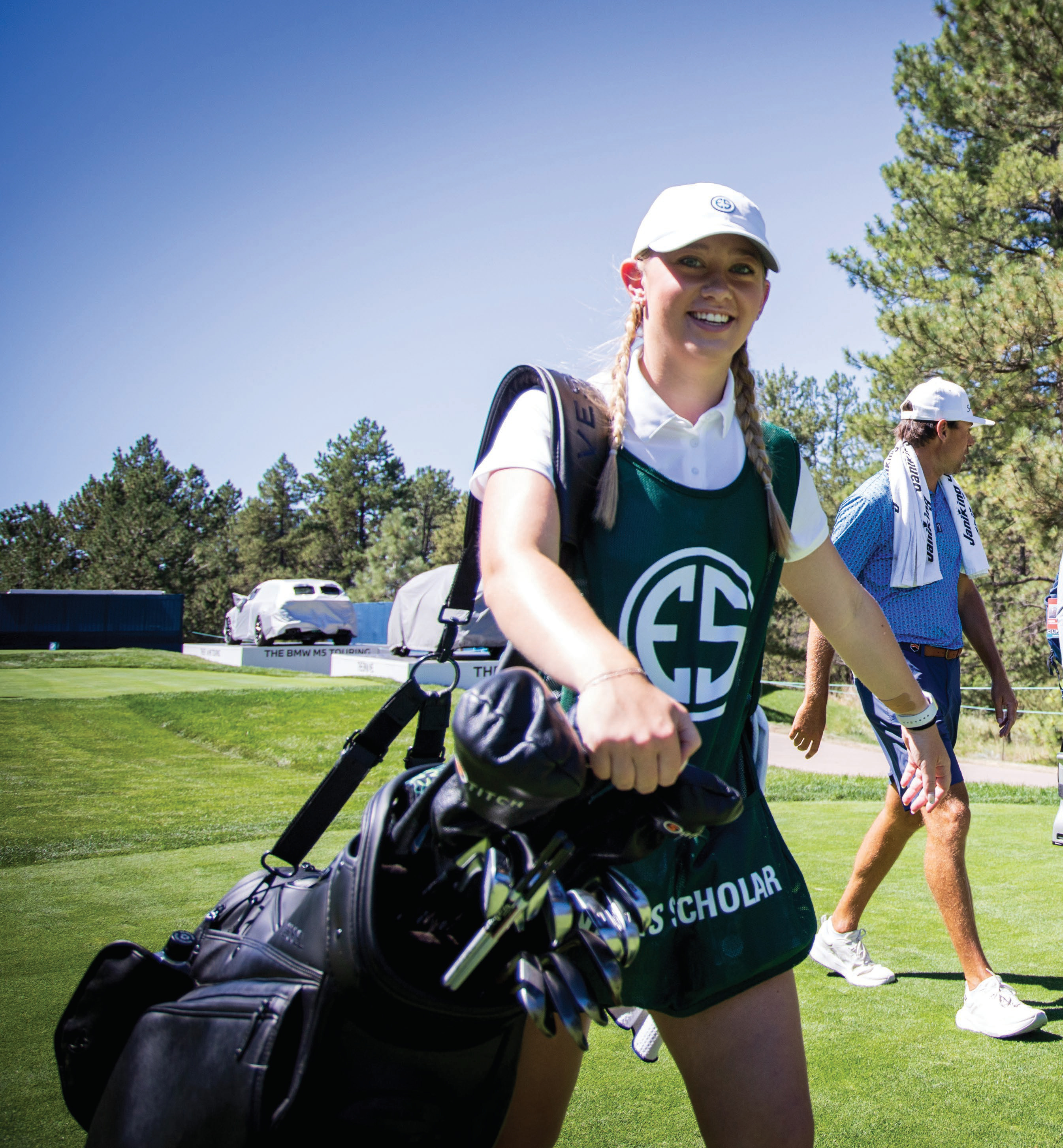
Nestled in the heart of the Colorado Rockies, Castle Pines Golf Club offers one of the most breathtaking— and challenging—golfing experiences on the PGA TOUR. At an elevation of over 6,000 feet, this stunning course provides players with a unique test of skill, strategy, and adaptability. But what makes Castle Pines truly stand out isn’t just its picturesque setting or the elevation itself; it’s the unique conditions that altitude creates for professional golfers. The 2024 BMW Championship, held at this prestigious venue, brought these challenges into sharp focus, pushing the world’s best golfers to adjust their strategies in ways that many had not encountered before.
For golfers like Wyndham Clark, playing at Castle Pines comes with a special sense of familiarity. As a Colorado native, Clark knows the intricacies of playing at altitude better than most, but even he admits that the course presents a set of challenges that are anything but straightforward. “It’s probably the toughest course in Colorado,” Clark reflected. “The ball flies farther, but that also means distance control is more difficult, especially with the elevation changes.”
As players descended on Castle Pines for the BMW Championship, they were greeted not only by the natural beauty of the course but by the unique difficulties that come with playing at altitude. For some, it was a welcome challenge. For others, it was an adjustment process that required meticulous planning and precise execution.
The Physics of Playing at Altitude
At sea level, the distance a golf ball travels is fairly predictable. Factors like club speed, spin rate, and wind all play a role, but there’s a general consistency that professional golfers have come to expect. When you bring altitude into the equation, however, things change dramatically. In the thinner air of Castle Pines, a golf ball travels significantly farther than it would at sea level—by as much as 10-15% depending on conditions.
This might sound like an advantage, especially for players who are known for their long drives, but in reality, it complicates things considerably. Distance control becomes more challenging, and players must adjust their expectations on every shot. For example, a typical 150-yard shot at sea level might carry closer to 165 yards at Castle Pines. That may not seem like a huge difference, but when precision is key—especially on a course with narrow fairways and small greens— those extra yards can mean the difference between a birdie and a bogey.
Wyndham Clark, who grew up playing in Colorado, understands these nuances better than most. “You definitely have to adjust,” he explained. “Even though I’ve played at altitude my whole life, it’s still a challenge. The ball goes farther, but it’s also harder to predict exactly how far. That’s especially true with approach shots and wedges.”
For many players, the adjustment process began long before they arrived at Castle Pines. Using technology like TrackMan and other launch monitors, golfers spent hours on the range recalibrating their distances for the elevation. “You’re going to see a lot of us spending time on the range, trying to figure out how far the ball is going,” Clark noted. “That’s going to be the biggest challenge—distance control.”
Elevation Changes: A Course that Defies Consistency
While the altitude itself poses one set of challenges, Castle Pines’ elevation changes add another layer of complexity to the equation. The course is known for its dramatic shifts in elevation, with some holes playing significantly uphill or downhill. These changes affect not only the distance the ball travels but also the way players approach their shots.
Take the iconic 17th hole, for example. Known as “The Ridge,” this par 3 plays downhill with an expansive view of the surrounding Rocky Mountains. It’s a visually stunning hole, but the downhill slope means that the ball will fly even farther than it would on a flat surface. Players must carefully calculate not only the distance to the hole but also the elevation drop, which can lead to misjudged shots if not accounted for correctly.
Rory McIlroy, who has played in a wide variety of conditions throughout his career, remarked on the difficulty of adjusting to the elevation changes at Castle Pines. “It’s not just the altitude—it’s the elevation changes on the course itself. You’ve got to think about your trajectory, your club selection, and how the ball is going to react when it hits the ground,” McIlroy said.
Adding to the challenge is the fact that Castle Pines is designed to punish errant shots. The course features narrow fairways lined with thick rough, and the greens are small and fast. This means that players must be not only long off the tee but also incredibly accurate. For many, the temptation to use the altitude to their advantage by hitting longer shots is tempered by the reality that even the slightest mistake can lead to trouble.
Adjusting Club Selection and Spin Control
One of the most significant adjustments players have to make at Castle Pines is with their club selection. At sea level, players rely on their distances with each club to make strategic decisions about which club to use for a particular shot. But at altitude, those distances are no longer reliable. A 7-iron that normally flies 175 yards might carry 190 yards in the thin air of Colorado, meaning players have to rethink their entire approach to club selection.
This adjustment is especially important on approach shots and wedge play, where precision is critical. Hitting an iron shot 10 yards too long on a par 3 could leave a player facing a difficult downhill putt or, worse, a tricky up-and-down from the rough. As McIlroy mentioned, the elevation changes make this even more difficult. “You’ve really got to focus on your club selection and make sure you’re choosing the right club for the distance and the slope,” he said.
Spin control is another key factor that players must manage at Castle Pines. At higher altitudes, the ball tends to spin less, which can make it harder to stop the ball on the greens. This forces players to adjust their approach shots, often opting for more lofted clubs to compensate for the reduced spin.
Mental Adjustments: The Challenge of Unfamiliar Conditions
For many players, the mental side of the game is just as important as the physical adjustments required to play at altitude. Golfers are creatures of habit, and the predictability of their game is often one of their greatest strengths. But at Castle Pines, nothing is predictable. Shots that would be routine at sea level suddenly become more complex, requiring players to rethink their strategy on almost every hole.
“It’s tough mentally because you’re constantly adjusting,” Scottie Scheffler noted. “Every shot feels different than it does at other tournaments, and that can be draining. You’ve got to stay focused and trust your adjustments, even when things aren’t going the way you expect.”
Staying mentally sharp is critical, especially as players navigate the final holes of a tournament like the BMW Championship. With so much on the line—including FedExCup points and Ryder Cup spots—the pressure to perform is immense. But at Castle Pines, that pressure is compounded by the challenges of playing at altitude. One miscalculation can lead to a costly mistake, and players must be able to quickly adapt and move on from any errors.
Wyndham Clark’s Edge: Local Knowledge
As a native of Colorado, Wyndham Clark has a unique advantage when it comes to playing at Castle Pines. Having grown up in the area, he understands the intricacies of playing at altitude and has spent years adjusting to the way the ball flies in the thin air. While many of his fellow competitors spent hours on the range trying to figure out their distances, Clark’s familiarity with these conditions gave him a head start.
“I’ve been playing at altitude my whole life,” Clark said. “I know how the ball reacts, how to adjust for the elevation changes, and how to deal with the wind. It definitely gives me an advantage.”
That advantage, combined with Clark’s recent success on the PGA TOUR, makes him a strong contender whenever he competes in Colorado. But even for Clark, the challenges of Castle Pines are not to be underestimated. “It’s a tough course, no doubt about it,” he acknowledged. “You’ve got to stay sharp mentally and physically, and you’ve got to make sure you’re making the right adjustments on every shot.”
Looking Ahead
The BMW Championship at Castle Pines provided players with a unique challenge—one that required them to adjust their game in ways they don’t typically have to at other venues. From managing distance control to navigating the course’s elevation changes, the players were forced to adapt to conditions that tested both their physical and mental abilities.
For some, like Wyndham Clark, playing at altitude felt like a return to familiar territory. For others, it was a new experience that pushed them to rethink their approach. But for all, Castle Pines proved once again that it is a course that demands respect, precision, and adaptability.
As the PGA TOUR continues to visit diverse and challenging venues, Castle Pines stands out as one of the most beautiful— and difficult—courses on the calendar. Its combination of natural beauty and unique challenges makes it a favorite among players and fans alike. And for those who can master the altitude, it offers the opportunity to create unforgettable moments in their careers.
Creative Credits
- Written by
- Sarah Miller
- Image courtesy
- Western Golf Association & Evans Scholars Foundation