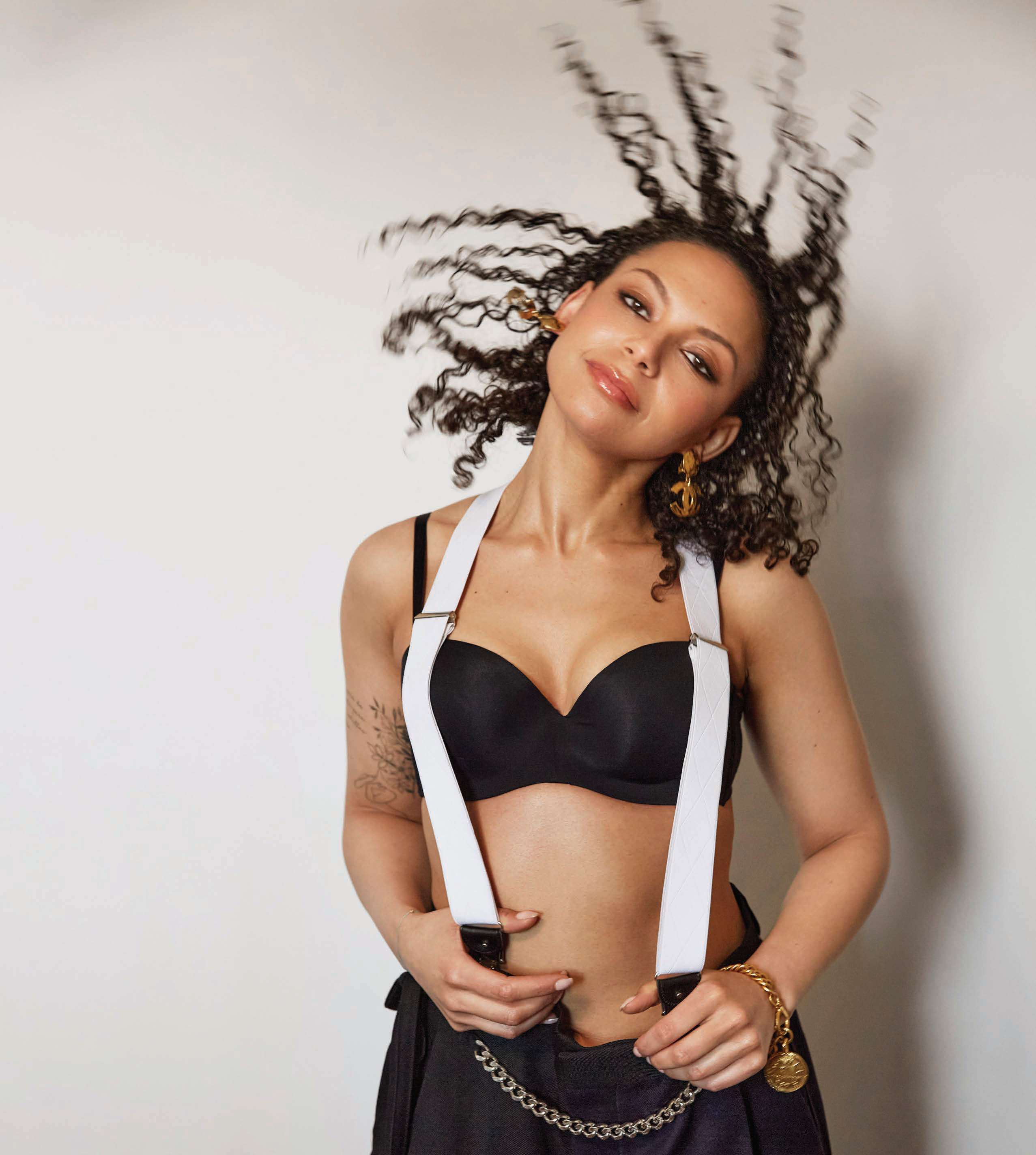
Lois Chimimba is a young Scottish actress with an impressive repertoire; featuring in both the popular Netflix series The One (2021) and the gripping television drama Vigil (2021), her career is booming. Lois’ professional journey started in theaters in 2014 when she starred as Te Lahu in Richard Bean’s play Pitcairn (a dramatization of British colonization). Just a few years later, in 2016, she starred in a successful National Theater musical called Wonder.land, working with talented musical artists such as Damon Albarn to reinvent Lewis Carroll’s classic; turning it into a thrilling modern dystopia where music and technology fused into a grand spectacle. Wonder.land and other fascinating Utopian narratives such as Doctor Who are what distinguish and characterize her acting career. She views these fantastical cinematic projects as testaments to the imaginative power of theater and film. Her passion for utopian cinema is made apparent as she marvels at the artistic potential of film: “cinema really can be whatever you want it to be, so why shouldn’t we try a bit of everything?”
When did you decide that you wanted to pursue a career in acting? What were the biggest difficulties/obstacles you faced whilst building your career?
I started taking drama and dancing classes at a young age, but I was probably about 14 when I definitely decided that I wanted to turn acting into a career. My mother warned me against it, telling me that I would have no money, and it would be a very difficult career path. But she didn’t deter me, and she always said that at least I knew exactly what I wanted. I guess the biggest challenge I still face to this day is finding a balance between being nice and easy to work with whilst also maintaining your integrity and sticking up for yourself. It’s something that I’m probably just starting to learn how to balance now. Another big challenge that I’m definitely working on right now is learning when to say no and accepting that there’s so much of my career that I’m not in control of. I’m trying to take ownership for the things I can control whilst also safeguarding my mental health: trying to keep positive when facing rejection on a daily basis. The biggest challenge is probably trying to be proactive and make the right decisions; when do you take a risk and when do you play it safe? All of these things are works in progress, but I have to say that, thankfully, I’m reasonably good at managing all of them.
What is the difference between cinema and theater performance and which format do you prefer?
I guess a big difference for me so far is the rehearsal time. When you’re working on a play you have four to five weeks of preparation, spending multiple hours at a time in a room learning about that world and character you’re trying to recreate. For TV and film you have much less time to prepare for your performance, sometimes you only have ten minutes of preparation before you do a scene. What I love about theater is rehearsals and being able to learn more about your character and I love the buzz of having an audience right there, especially if something goes wrong and you have to improvise. It’s really exciting. Film and TV is stimulating in a different way, you have something new to do every day, every day is always really different and that’s what makes the whole experience exciting. I think I would say I like them both in equal measures, both have an equal amount of challenges and amazing qualities.
In the future, do you see yourself committing fully to either theater or film or do you think you’ll continue participating in both theatrical and TV productions?
In an ideal world, I’d like to do both, both of them are thrilling, rewarding and require a lot of hard work. It would be a dream of mine to be able to flip between the two.
What does it feel like to watch yourself on TV? Do you ever get used to it and what was it like the first time you saw yourself?
I feel like now I am kind of used to seeing myself perform because it’s happened enough times for it not to feel surprising anymore. But it’s still very hard to totally enjoy the movie or show without critiquing your performance. I always worry about whether I am actually any good. I feel proud if the project is getting attention and people like it, but I’m also totally riddled with worry. As much as I definitely try not to care about what other people think, I would like to feel in myself that I’ve done a good job. Although it’s still a little difficult for me to totally separate myself from what I’m watching and viewing it objectively, it’s nice to see yourself on the screen and feel like you’ve achieved something. Overall, it’s a nice feeling even though its marginally stressful.
Which character did you most enjoy playing and which character are you most tied to?
I think probably the answer to both would be Hannah, the character I played on a show called The One. Compared to jobs I had previously, I was given more creative freedom. Every day that I was on set we were mostly working on scenes that I was in. We would be working on the character with Eric Kofi-Abrefa, the actor who played my husband, so it would be a whole day of working on our storyline. I was able to connect with the director and I was involved in artistic decisions, so it felt like a collaboration which I’ve realized is how I want to work. When you’re on set you should feel like you’re being heard and your opinion is valued but that isn’t always the case. On The One I was spoken to as an adult and my opinion mattered. And I also loved playing the part; she was mad, but I could totally relate to her and at that stage in my career it was the most like myself I ever felt on set.
What was the most challenging role you had to interpret?
In 2019 I did a play at the Almeida Theatre in London, a version of Chekhov's Three Sisters, and I was playing Natasha. The character is a bit of an outsider and I really felt like for the first time the fictional world of the play seeped into my real life. I felt like an outsider throughout the rehearsal process and I found it quite difficult to navigate my feelings and understand if my emotions were simply a result of me playing Natasha or if I was actually struggling in my professional life. Up until that point I had only really worked on new writing so I couldn’t compare my acting to other performances. Chekhov was a completely different experience because it’s been played remarkably by so many actors, so I felt pressured to try to do an interpretation that was fresh whilst still hitting all the marks that you are meant to hit in Chekhov. It was definitely a process that I struggled with but in the end playing Natasha was probably one of my most fulfilling roles.
How do you prepare yourself for a role? Are there any specific techniques?
First of all, I try to scur the script for as much information as possible. When I was in drama school they would ask us to create a backstory or invent things that happened to our character in the past. I don’t really do that, I pretty much try to get all my information from the script so that I know that the background information is totally accurate. I read and reread the scenes as often as possible so the words start to feel as my own. Usually, I also practice scenes with friends or actors that I trust before going on set or in the rehearsal room. This way I can get notes from someone who knows me really well and can tell me what my habits are, so I don’t fall into the same patterns. I try to get as much as I can from the script but I have realized that collaborating with the director and hearing someone else’s perspective is how I work best. I like to give my own interpretation of something but I do enjoy feedback to really coax out what everyone in the team wants to get.
You’ve been featured in multiple utopian/fantastical narratives like Wonder.land and The One, is there something in particular that draws you to these narratives?
I guess what I love about theater and film is that anything is possible so I love stories that are set either in the future or in totally made up versions of reality. I just think that’s wonderful because with art why shouldn’t we be able to make up whatever we want. Recently, I watched a French film called Titan and I found it so thrilling because it was so mental that it just made me feel like film really can be whatever you want it to be, so why shouldn’t we try a bit of everything? I think that’s what excites me about doing something totally new.
What actors/actresses do you look up too?
I think I definitely connect really deeply to other mixed-race actresses like Maya Rudolph, Zendaya, Zoe Kravitz, I feel like seeing them on screen shows me that there is a space for me in this industry and there is absolutely a chance of huge success so it’s nice to see faces that reflect you. But my number one inspiration would be my friend Saffron Hocking who’s an actress, she’s about to appear in the latest seasons of the Netflix show Top Boy, we worked together during our first ever play and have been joined at the hip ever since. Not only am I inspired by her talent but she’s basically a shining light that manages to keep me motivated and positive within this industry. Sharing your concerns and hopes with someone who understands the ups and downs of an acting career can really drive you to work harder.
Which contemporary movie director do you admire the most and which director do you hope to work with in the future?
I’m going to think big and say Jordan Peele because not only do I love his films, but I also like the actors that he chooses to work with. I like his energy because he chooses to work with not only talented but also good people. Another person I’d love to work with is Shonda Rhimes, she’s not a director but so many of the TV shows that she’s created are so totally addictive and I would love to be a part of something that is integrated in so many viewers’ lives.
What was it like, shooting with Covid regulations? How big of an impact did Covid have on your career and in general on the film industry?
Yeah, things were really different, and it was quite hard, but we were all so grateful to be working again. We tried to make the best of it, but we were getting tested on a really regular basis, so it wasn’t great. On some shows you were having to isolate from other actors between takes so it was difficult to engage. That was a shame because so much of the fun of being on set is meeting new people and getting to know the actors you are working with. At least actors could take their masks off to act whilst the director, the crew and hair and make-up artists spent all day in safety gear, so you could see it took its toll on people. But I guess it was a testament to how much we love film because we managed to keep moral up but ultimately I look forward to the conditions returning back to how they were before Covid.
Have Covid regulations toned down since the most recent lockdown?
The regulations defiantly toned down, during lockdown we couldn’t even travel on public transport because we couldn’t risk catching things from strangers. It’s definitely eased up now but there’s still a good number of safety measures in place.
Creative Credits
- Written by
- Gaia Stanzani Ghedini
- Photography
- Alisa Connan
- Fashion direction
- Arabella Boyce
- Styling assistant
- Kitty Bowes
- Retouching
- Brianna Kish
- Hair Stylist
- Darren Fowler
- Makeup Artist
- Lan Nguyen Grealis