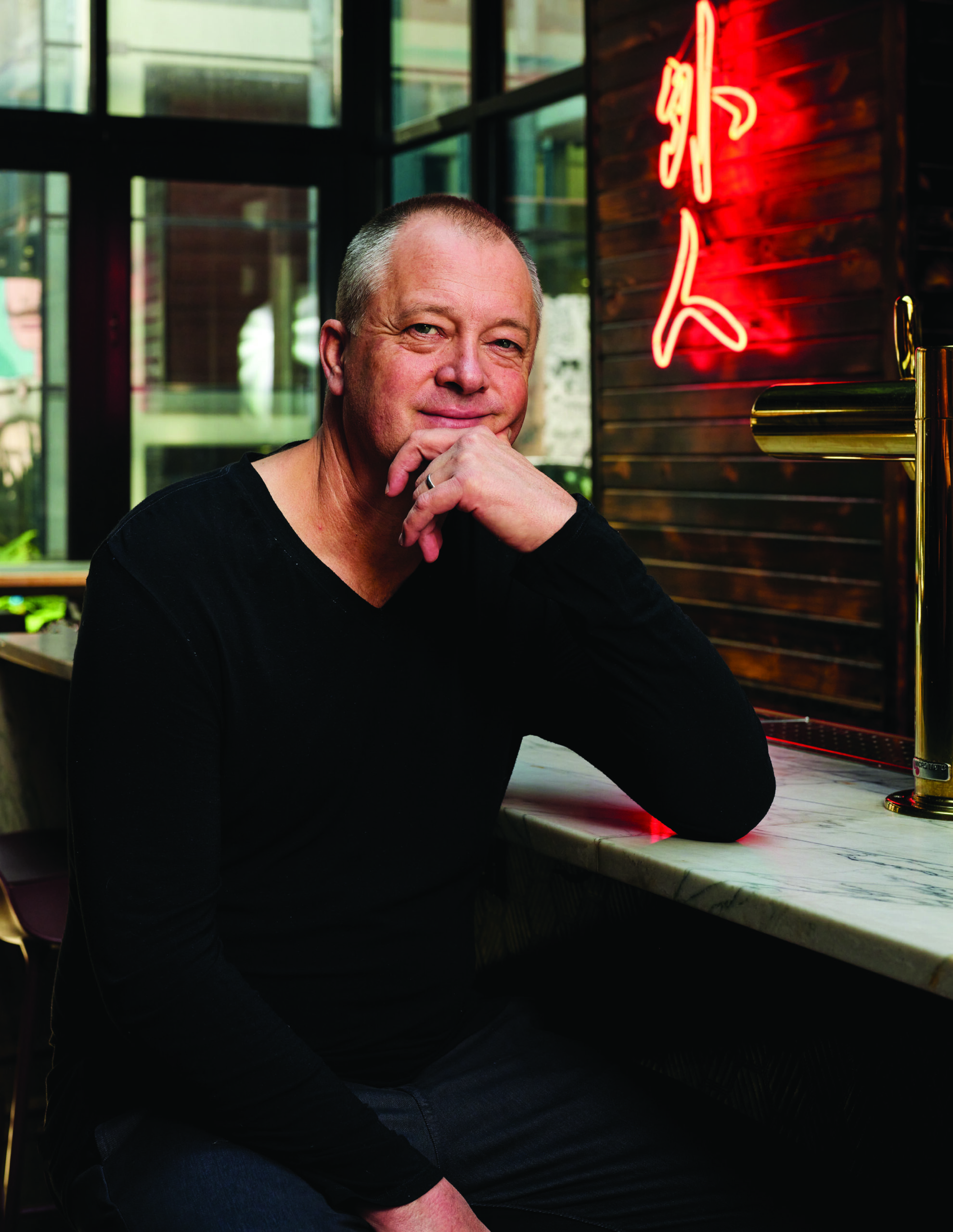
Chicago area restaurateur, Paul Virant, recently closed a pivotal chapter in his impressive culinary life. Yet, another one will open soon enough.
Chef Paul, who grew up on a farm outside of St. Louis, has been making continuous moves in the industry since the 1980s. His journey to become an executive chef and entrepreneur is steeped in history, having worked in many renowned Chicago and New York City restaurants. His work in his own restaurants has earned him many accolades, including 2015, 2014, 2013, and 2011 finalist nominations for the James Beard Foundation Award’s Best Chef: Great Lakes. Chef Paul also competed on “Iron Chef America” and missed a win over Iron Chef Masaharu Morimoto by just one point. These are just a few highlights.
Today, he owns Hinsdale steakhouse Vistro Prime, as well as Gaijin, Chicago’s first and only okonomiyaki restaurant. Chef Paul, also a canning expert, has co-authored a recipe book and subsequently launched a line of artisanal jarred products.
We recently caught up with him following the closing of his first restaurant, Vie, for which he earned a Michelin star, to learn about his journey to this point as well as what’s next.
You’ve been a chef for over 30 years. When did you decide this was the career for you?
I started working in pizza joints in high school. I was a soda jerk at a restaurant at the Six Flags and got exposed to short order cooking, making malts, shakes, and floats, splits and sundaes. I then went to work at this place called The Smoke House, and the owner introduced me to Simone and Gilbert Andujar, who had the French restaurant Malmaison. It was considered one of the top restaurants in the St. Louis area at that time, and I started working there. That was probably the most influential, inspirational move—when I started working in a restaurant that did everything in-house.
Did you get all your education in restaurants?
I went to Wesleyan College in West Virginia. They had a great program in nutrition, which made sense because I was committed to going to culinary school. So, it was nice to be able to dive into the science of food.
Culinary school was the Culinary Institute of America in upstate New York in Hyde Park, right on the Hudson River. Because Hudson Valley has a pretty deep agricultural history, there were a lot of farms, a lot of wineries, and a lot of emphasis on local food. I worked at Cascade Mountain Winery, initially in the vineyards because I wanted to learn about viniculture. But they had a little restaurant, so I ended up cooking there. On the weekends, I would take trips into New York City to visit restaurants, and those years really shaped a deeper understanding about food from a broader sort of international scale. After growing up in a small town and living where I had, I was blown away by the ethnic diversity I hadn't seen before.
What was the restaurant scene like in NYC then?
I had done stages and applied for jobs at some of the greatest restaurants in the country, like Bouley, Aureole, Park Avenue Cafe, Le Bernardin. I mean, these were iconic, and it was a great time to be there. Bobby Flay had just opened his first place… It was an explosion of hospitality and restaurants.
Wayne Nish was the chef/owner of March, and as a midwestern boy intimidated by the City, there was something about a small restaurant… And I felt a connection to Wayne—his mannerisms. So, I took a job as a cook there. Because of his Japanese heritage, there was Japanese-Asian influence on the menu, and he did a lot of sourcing in Chinatown. I happened to live in Jersey City, so it was convenient for me to stop in Chinatown on the train and shop for the restaurant.
How did exposure to these ethnic foods impact you as a chef?
I think the exposure to these foods, like different Asian foods, exposed me to the idea of acidity and how that really works with balancing plates and richness, because you think about Japanese food and their pickles and Indian food and their chutneys and pickles, and Korean food—a lot of pickles and fermented things, and I hadn't had any of this stuff. So, it ended up being a huge part of the food I would ultimately do at Vie.
What would take you from NYC to Chicago?
You know, it's funny how life works. I was in a pretty serious relationship, and it ended. And I didn't have anything other than my job because I worked a lot. I was living with a buddy from college in a one-bedroom apartment, and it wasn't ideal. So, I went back to St. Louis and planned to re-establish there.
I did a lot of stages, and I went to different restaurants that were doing cool stuff. But it was quite a change from New York and just didn't have what I needed for further development. My younger brother was starting medical school in the Chicago suburbs, so I came up and did stages and interviewed at a handful of restaurants. And I landed at Charlie Trotter's, which was probably the most famous of all restaurants in the United States at that time.
What was it like to work at such a famous restaurant?
I was fortunate to have worked there when it was kind of at its peak. Part of a Julia Roberts movie, “My Best Friend’s Wedding,” was filmed in the kitchen, and Charlie had just released his second cookbook. There was a lot of stuff going on. And, I think it would have been a great home for me for years, but unfortunately, there were certain elements of the kitchen that were sort of cutthroat. There was sort of a hazing period… a lot of mental abuse. It ultimately was not a good fit for me. I ended up staying about six months and then landed a job at Ambria as a saucier. It was a great fit.
Your time at Trotter’s sounds nearly miserable. Were there any good moments?
Right at the tail end of Charlie Trotter's is when I started dating my now wife. She was in medical school at the time. We got married in May of 1998 and moved to Hawaii for her residency. The fact that I worked at Trotter’s was pretty influential anywhere I applied. I ended up getting a job in pastry with Philippe and Pierre Padovani. They were opening Padovani's Restaurant and Wine Bar, a real high-end place in Waikiki. It was a great experience, but my wife wasn’t happy in her residency. So, we moved back to Chicago about a year later.
What did you do after returning from Hawaii?
When I got back, I was hired as the executive sous chef at another iconic restaurant, The Everest Room, which is rare because chefs and cooks are often promoted from within. Gabino, the owner of Ambria, vouched for me with the owner, Jean Joho.
I worked there for a couple of years, but a lot of these older restaurants don’t change their menus that often. There wasn’t a lot of creative input from somebody like me. So, I ended up taking a chef job at The Outpost in Wrigleyville. I got some accolades from The Chicago Tribune, but the job was kind of short lived. One busy night, there was a large rat that basically ran across the top of the stove and fell on the grill.
It was crazy. I got into a heated argument with the owner and [eventually] left. But it was interesting because The Outpost was a launching pad for a bunch of chefs who ultimately would have their own restaurants. So that's the one thing it had going for it.
Was it then you decided to open your own restaurant?
At this point, I wanted to do my own thing. I had gotten to know Paul Kahan who had Blackbird Restaurant but now owns One Off Hospitality and other restaurants. We were talking one day at the farmer's market, and he told me he could use help with private events. I ended up working, really, with him, not for him, and it was a cool experience. Plus, my wife and I had our first son. The flexibility gave me a chance to help with our son.
I worked with Kahan until probably six months before we opened Vie, which was in August of 2004.
How did the concept for Vie come to be?
We were living in the Ukrainian Village and decided to move to Hinsdale, to the suburbs, to shorten my wife’s commute. We learned that nearby Western Springs was a dry town with no restaurants, and residents overwhelmingly wanted a restaurant with a bar. Hence the birth of Vie.
We were the first restaurant to have a liquor license in town. The premise of that restaurant was a culmination of everything I had done prior. And I really wanted to support the Midwest farmers and artisans. It was like, let's be seasonal; let's embrace the growing season and do a lot of preserving. I had really gotten into pickling and the fermenting and, again, how acidity balances out dishes… and it all came together. And that's what we did forever.
How do you feel about Vie’s closing?
It was definitely bittersweet. We’ve had a tremendous run. We were open over 19 years. Everybody knew it was coming, so there’s been a lot of reminiscing with customers, sharing old memories. The last dinner service was more of that and a lot of hugs. It was an emotional night for sure. But there’s a silver lining.
I bought a building, and we’re going to reopen with a change to ‘Petite Vie,’ a French café and brasserie. This is going to be a six-day operation—lunch and dinner, brunch on the weekends. It’ll be a smaller space, but people will be able to anticipate their experience [with a static menu]. I’m hopeful for opening in Spring 2024.
You’re focused on your other restaurants, Vistro Prime and Gaijin. And, you also have a line of products, Jar Sessions, and wrote a book. How did the latter come to be?
We had a core number of recipes for pickles and things that we use at the restaurants, and a food writer, Kate Leahy, came in and did an article about Vie’s food. It had a lot of Midwestern influence and some European influence, but it was unique because we would take pickled fennel and turn that into a vinaigrette or a butter sauce—things that were pretty original. She was intrigued and did an article on it. Then she approached me and asked if I would consider writing a book. So, we wrote “The Preservation Kitchen” that has the recipes for the preserves, pickles, and everything. And it just made sense to start a product line.
Of all these accomplishments, what is your biggest achievement?
It's funny because we've been talking about this a lot lately with Vie’s closing. I think the big accomplishment for people like me is the memories you create for people and families. The idea is to provide a great experience. Let's provide a moment in time for you and the people you're with, whether family or friends or maybe even business. We want to give you an experience that hopefully will be a positive memory.
Stay with Felix as we share more on Chef Paul’s endeavors in coming issues. In the meantime, you can follow him on Instagram @paul_virant.
Creative Credits
- Written by
- Jessica Catignani
- Photography
- Meagan Shuptar
- Retouching
- Brianna Kish
- Hair & Makeup
- J. Esther Han of The LAB Artist Agency
- Venue / location
- Gaijin 950 W. Lake Street, Chicago