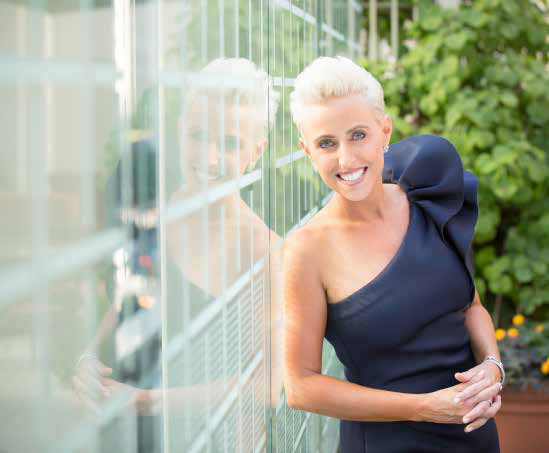
In difficult times, it may be easy for young people to think there is no way up, no way out, no way to distinguish oneself without support or assets. Laura Schwartz is a successful on-air commentator, journalist, and the author of “Eat, Drink and Succeed”. Her popular podcast features interviews with top business minds and Chicago captains of industry. She is also the former White House Director of Events under President Bill Clinton. Schwartz is recognized as a leading authority in helping others to create successful professional journeys.
In 1993, at only 19 years old, she was anxious about her future and her lack of connections or career options. She explained:
“It’s true, I was 19 when I got the opportunity to transfer to American University. I decided to volunteer with the White House transition team the day after Bill Clinton’s inauguration. No one gave me the time of day! I had to figure out, by myself, how to support everyone who had work to do. Honestly, to any young person reading this, I was not in a Kardashian culture, starting as a CEO.”
She shared a quote she prizes from actor Steve Martin:
“Keep your head down, work hard and be so good, they can’t ‘not notice’ you.”
Swartz quickly found that the work wasn’t glamorous and that her first lesson was to be humble and work hard. There was much for her to learn.
“Yes. I filled the office toner with ink. Ran errands. While answering the phones I soon knew all the powerful people who called. It’s amazing that even when you only provide a small service, like conveying a message, people learn your name.” Like Larry King, she believes:
“I never learned anything by talking. Sometimes I could escort a crew after a call came in and learn from that, too.”
When we wondered if she had any personal mentors at that age, she pointed out:
“Mentors can be people who don’t know they are. Evelyn Lieberman, the first female Deputy Chief of Staff, always got things done. The President and everyone listened to her.”
She recommends that young people ask individuals they admire:
“Who sets a high bar? Then ask those individuals who it is they admire, who it is that sets a high bar for them.”
Schwartz admired Eleanor Roosevelt, Oprah Winfrey, Hillary Clinton, and Marion Wright Edelman. She considers them all as her “mentors”. She believes finding a mentor for oneself is of primary importance.
“You can build a networking diagram that way for yourself. Even at a young age, that diagram should always be expanding. I tell people to ask themselves two questions: “Who am I?” and “Why am I here?” If I’m hanging out with the wrong work people, ask yourself if I can change that. Same thing in a bad, personal relationship: ask, who am I and why am I in this negative relationship?”
In her book “Eat, Drink and Succeed” Schwartz encourages her readers to think of networking not as ‘what people can do for you’, but instead to think of networking as ‘what you can do for them’.
“You can build important “bridges” for yourself if you recognize the important social scenes in your life; at work, at school, on social media, etc. Look for new ways to use them to expand your social and professional reach. If you try to actively build “bridges” to others by helping them meet their goals before you identify people to help you achieve your own, you are building stronger bridges to success for yourself.”
In her book Schwartz offers wonderful advice that even a high schooler can follow to build a social or work support network for themselves. She suggests they use on-line or free media to research local calendar events and organization websites where there might be an opportunity to help or change a life. She counsels readers to research ahead of time who’ll be at an event. Attend free lectures and conferences, explore which local industry or social organizations of interest you can join. Find out where you can make a difference in some way. Also start a notebook in which you keep notes about what you’ve learned in these encounters.
We particularly wondered if she had any other advice for young people such as the girls of the Aparecio Foundation?
“Don’t try to know right away exactly what you want to do: build knowledge by doing for others. If you have an idea of what interests you, do it first by volunteering. –There may be an aunt or an uncle who might have a job. Social diagram your life. See who it is you know; find out what they need to get ahead.”
She points out that she has learned from Millennials that you can mentor yourself, too. She suggests that if you want to attend a function and don’t have the funds, don’t be afraid to call even producers and ask if you can volunteer so you can attend.
We inquired if there was any situation she perceived as a personal failure that taught her valuable lessons.
“A personal relationship with a boyfriend I got lost in. It really helped to ask myself: “Who am I? Why am I Here?”
When we noted she had mentored herself in that situation, we asked who she considers to be her most significant mentors. She cited her parents and President Bill Clinton.
“What I so loved about working with him was that this is a guy from Hope,
Arkansas, someone everyone knows, who still said ‘Hello – I’m Bill Clinton’. He taught me no one is above introducing themselves and that it’s important to know how to engage people in short conversations.”
We wondered what teachable moments in networking or personal communications are to be found in our unusually divisive political climate.
“PR and communications are much different than they were five years or even one year ago; they are constantly changing. If you want to deliver any information, political or not, you should notice where your targeted audience is most often receiving it. This gives you a sense of what type of content to produce, where to deliver it, when, and specifically to whom. Also, who is competing with you message for your audience’s attention? Communications and PR are becoming more and more content driven.”
Schwartz provides readers and students with a primer for thinking critically about the messaging we consume. She also provides a powerful message when she suggests that any personal, social or work network become first a vehicle for “giving, not getting”. That’s certainly a game changer.
She further advised asking ourselves:
“What IS working in this country and what we can do to make it work even better.”
It is clear her guidelines can be called upon to help establish a set of networks and bridges for ourselves. She concluded with a most valuable last reminder:
“Mentors!”
Creative Credits
- Written by
- Leonora Francesca Flores
- Photography
- Alissa Pagels