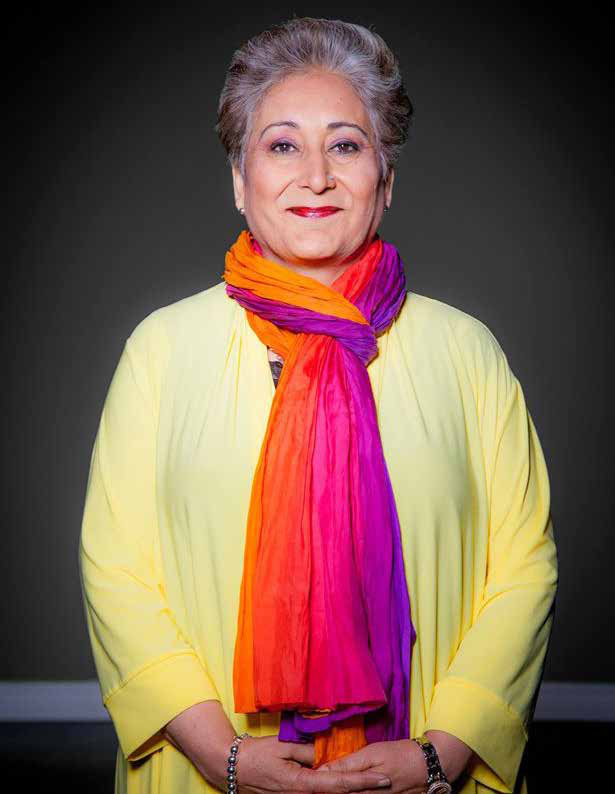
Raheel Raza is a Muslim woman and passionate political activist, filmmaker, journalist, author, and interfaith public speaker. It is her conviction that women’s rights are harder to defend than human rights because they are usually considered as only the responsibility of individuals and local government.
In her book Their Jihad, Not My Jihad Raza courageously makes the point that it is Political Islam which has hijacked the spiritual version of the Islam that Mohammed brought to liberate men and especially women who had been victimized by brutal and mysogynist caliphates existing before Islam. The point of Political Islam is explicitly to nullify the Muslim woman’s right to vote, to own property, to be educated, to get divorced, to run businesses, to be judges and to keep their maiden names. Political Islam is about political expansion not about spiritual life.
In a recent TED talk, Raza explained that Mohammed’s own wife Khadija had been greatly admired for her social philanthropy and as a businesswoman. It is she who modeled the freedoms Islam brought to women.
Within 100 years of the Prophet’s death the rights of Muslim women were also dead. Political Islam supplanted Mohammed’s vision for a spiritual Islam of peace and cultural tolerance. It was able to firmly re-establish itself through textual emphasis on certain passages within the Qu’ran and the Hadiths (the teachings of Mohammed) while ignoring any teachings featuring women’s rights. Raza is deeply concerned that Westerners not conflate Sharia Law with Islam.
LF: You are a tremendous role model for Muslim women and for all women, not least for the girls of our own Aparecio Foundation. I would like to you to describe how a cultural narrative can ever rationalize honor killings of women?
RR: The ‘new narrative’ I call for is on the website of my documentary Honor Diaries. It begins with us, as Muslims, moving into the 21st century. Men are perceived to be the creators of honor in Sharia Law. It is only women who are able to dishonor their culture. Some Sharia laws justify abusing and killing women only for being perceived to have dishonored her husband, family or tribe.
LF: Can you elaborate?
RR: In tribal ideology, there is just a necessity to protect the freedom of the patriarchal leadership of the tribe. No one has personal freedoms, especially women.
LF: How can education transform Muslim women’s rights?
RR: With enlightenment comes change. Islam teaches that men and women are created from a single soul, not for instance, from a separate Adam and Eve. When I first asked to read the Qu’ran for myself, I read that God said “I have created men and women equal.” The concept of maiming, abusing or killing women for what men perceive to be HER violations of her family, tribe or city’s honor is NOT from Islam. But honestly, a lot of Islam is practiced in Third World countries where there is no clean water and high infant mortality. Women there don’t have time or resources to fight for their rights.
LF: Is there much access to the internet in these Third World areas to facilitate education of women’s rights; especially since Muslim political radicals use the internet to radicalize and recruit political Muslims with a narrative that debases women?
RR: My organization Muslims Facing Tomorrow is a grassroots Muslim organization working to fight extremism and separating mosque and state. Through it, we partnered to make the documentary Honor Diaries, to discuss challenges and abuse faced by women in Muslim majority areas. In 2013 we did a very promising pilot project in Bangladesh to declare a village radical-free, in part by educating young women to know what the Qu’ran really says about womens’ rights. One young woman even confronted a local Imam. She told him: “I can read the Qu’ran myself now! You are not teaching us the truth!” He left the village in shame, showing the fallacy of Sharia Law to the rest of the village. We now have twelve villages identifying themselves as ‘radical-free” in Bangladesh and there’s a documentary coming that explains how and why we did it.
LF: What an effective use of education as a means of counter-radicalization.
RR: Yes. I also travel to 100 campuses to speak with college students. Every change starts with young women. In Cairo, where the percentage of honor killings and FGM (female genital mutilation) is very high, our film Honor Diaries has gotten a million “likes” asking the question “how can we help?” Unfortunately, in my own country of Pakistan, honor killings have increased lately. In Muslim majority communities, it is actually hard to prosecute “honor killers” because in Sharia Law, the family of the victim is allowed to forgive the killer, who is usually their family too. The murderer goes scott-free, the victim is dead and the family gets bribes and won’t deal with the crime. This has to change.
LF: You have an impressive group of Muslim female philanthropists living in the West who are fighting for the rights of victimized Muslim women in your film Honor Diaries.
RR: All my female colleagues in Honor Diaries are very educated and powerful Muslim women from different backgrounds. Our diversity shows there is no such thing as a monolithic Muslim face. We know women are abused all over the world; but in the West women have enforceable rights and social recourse if they are abused. In Muslim countries misogyny is institutionalized, making it easier for everyone to accept a legal system that encourages abuse of women.”
LF: What have been the biggest obstacles your movement has faced to get support from the West in this fight against honor killings and the victimization of Muslim women?
RR: Cultural relativism! (she groans).
editorial comment: (Cultural Relativism is the view that moral or ethical systems, which vary from culture to culture, are all equally valid and no one system is really better than any other. Therefore, any opinion on morality or ethics is subject to the cultural perspective of each person).
RR: Cultural relativism is even built into the UN Bill of Rights. In the West, people shy away from noticing a teenager kidnapped from high school who returns months later as a forced bride; or girls who go to the police all bruised and battered to say they think they’re about to be killed by their families. Westerners often believe female abuse is symptomatic of Middle Eastern cultures and that they shouldn’t try to interfere so no one can accuse them of being politically incorrect or “Islamophobic.” Radical Muslims also use cultural relativism against Westerners and Muslim womens’ rights advocates to confuse and deflect criticism of abusive Sharia Laws.
LF: What can you say to counter that?
RR: “It is not part of anyone’s culture to be abused! Ten years ago you couldn’t mention honor killings in any UN proceedings. But the first lady of Burkino Faso just brought it up there and now I’m happy to say it’s officially on the agenda. Public discourse and women networking with other women really helps. I wish mainstream women’s groups would offer more support to Muslim women victimized by honor killing practices. Being a feminist means supporting all other women.
LF: I agree. Is there anything else you’d like to say to our readers?
RR: Women don’t just need to have rights, they need to continually be able to refine and discuss them. My message to women is to speak out: don’t be silent if you see A N Y woman getting abused. And spread the word. Raza’s advice is not to be taken lightly. She and the members of her organization ‘Muslims Facing Tomorrow’ are building savvy advocacy networks to create what political scientists Margaret E. Keck and Kathryn Sikkink call a necessary global context for their cause, Activist Beyond Borders, which advocates the use of : informational politics (accurate reporting of global Muslim womens’ abuse statistics), symbolic politics (an archetypal cultural symbol for the horror of the abuse to which anyone can relate, from any culture), leverage politics (reaching large international power brokers like the U.N. and western countries to tie Western financial aid packages to mitigation of womens’ abuse patterns in the offending countries).
Raza works toward these goals through her public speaking, through her ties to the UN community, her journalism, and with accountability politics. This involves creating public records such as her Honor Diaries documentary which demonstrate actual political commitment to change.
Raza is a bonafide cultural hero one doesn’t meet often, in history books or in life. We are honored to be able to share meeting her with our Felix readers.
Creative Credits
- Written by
- Leonora Francesca Flores
- Image courtesy
- Raheel Raza