If you’ve perused the fashion magazines lately you’ve no doubt witnessed a new phenomenon taking place: women with gray hair walking the runways. Granted, they are some pretty spectacular looking specimens of ageing well: 85-year old Carmen Dell’Orefice, 71-year-old Veruschka, 73-year-old Lauren Hutton, 79-year-old Vanessa Redgrave (in a Gucci Spread in Bazaar) and 80-year-old male model Wang Deshun.
Beyond the runway there are signs – and growing societal recognition – that those who are living a long life, well-lived have something significant to contribute to a healthy society. These are people who are reimagining ways to stay visible and engaged in a hyper-speed world that reinvents technology every few years. At the same time, nearly every fashion magazine offers up images of 15-year-olds as examples of ideal beauty.
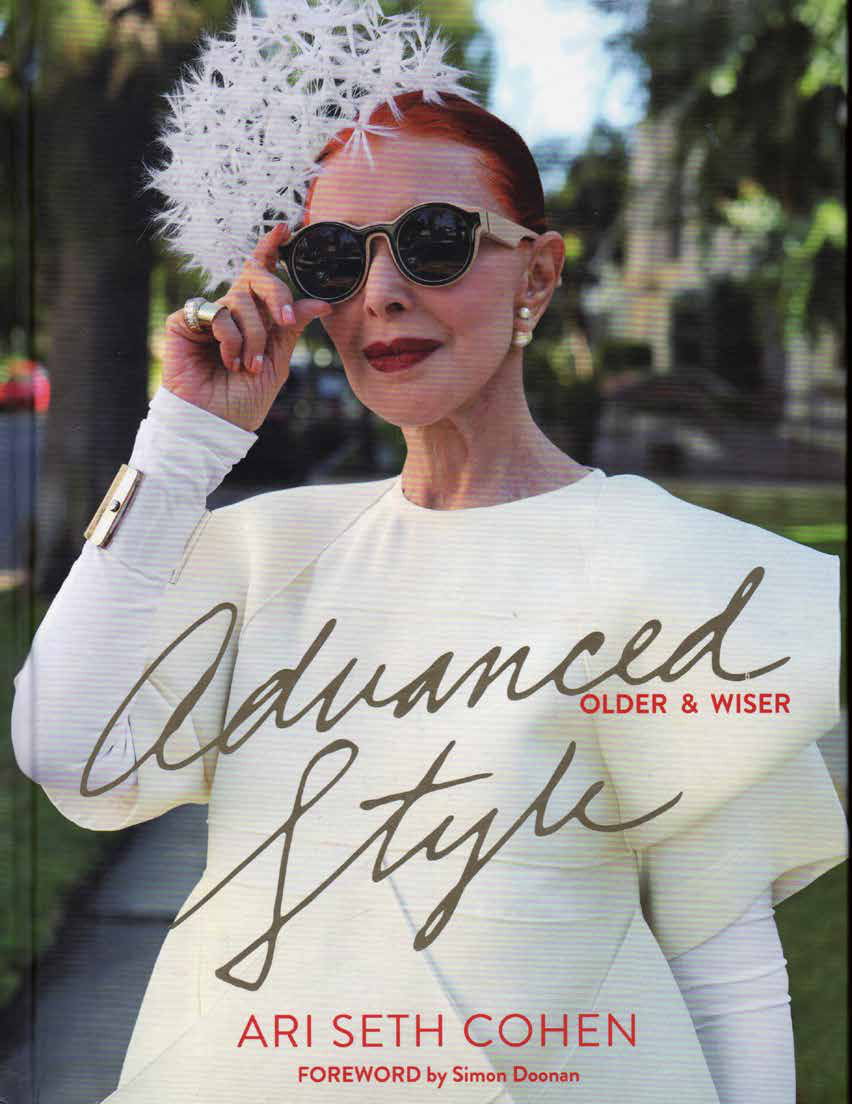
For many staying connected and engaged with life as we age has less to do with the world of fashion or beauty and more to do with how we live. There is something to be said for showing up, visually. Case in point: the book “Advanced Style” by Ari Seth Cohen. On the cover of Cohen’s book is Valerie Von Sobel, who also happens to be on the cover of Felix Magazine’s Spring issue. It’s become something of a cliché to say that one of the advantages of age is that you really don’t care what people think of you any longer. Cohen, on his Advanced Style blog, has demonstrated the truth behind the cliché by featuring a coterie of joyfully eclectic older women who are making fashion a personal manifesto against ageism some of them in colorful, take-no-prisoners attire. One in particular, 91-year-old Iris Apfel, has volleyed her new-found celebrity into a fashion line, media appearances, and even her own emojis!
What we’ve learned from these new fashionistas is that wearing color, attending to grooming, and being authentic representatives of their own unique style are the things that make them a joy to behold and an inspiration for how life can be.
The value of staying visible as we age isn’t to be taken lightly. Invisibility invites isolation that contributes to a wide range of physical and emotional ills. Social isolation, whether imposed or chosen, alters the chemicals in our brains and compromises the immune system, both contributing factors to heart disease and dementia.
Staying connected, and participating in new adventures develops what is called “brain plasticity” which is the ability to form new neurological pathways in the brain. According to neuroscientist David Eagleman it also helps slow down time, something that seems to zip by faster as we age.
“The more familiar the world becomes, the less information your brain writes down, and the more quickly time seems to pass. Time stretches out when you really turn your brain resources on.”
The challenges of aging associated with isolation and invisibility are compounded for those in any marginalized group. Denise Lampron, the founder of the Greying Goddess, whose mother was of mixed racial heritage, (African-American and Native American), and whose father was Caucasian explains,
“Aging is now a business. The greater community still does not think Blacks have buying power or marketing influence, even though stats indicate otherwise.”
That translates into fewer images in media of older women and men of color. In an earlier, agriculturally-based era marginalized populations relied on each other for their very existence and elders held a place of reverence in the family. Lampron says:
“Upward mobility has made the tradition of keeping the family generations together more difficult. The strong female is still very much part of the Black landscape, but I believe her role is shifting. Generations are having fewer children and there is more focus on education, professional pursuits, etc.”
Unless the bonds of family and friends have remained strong over the years, physical illness and disability can take us off their radar. It’s easier to be ignored when we have less to contribute materially or intellectually. That’s why the mantras of “good nutrition, adequate hydration and physical exercise” become crucial. Maintaining muscle strength is a key part of that. According to Health and fitness expert Debi Silber:
“Developing strength insures that daily tasks don’t become burdens. When you preserve your strength you preserve your quality of life. Anyone who has struggled with an un-openable jar lid or attempted to lift a grocery bag packed by a strapping 18-year- old can attest to this.”
A simple path to visibility involves simply making a conscious effort to improve our posture. The posture typically associated with aging, slumped and bent, is one of defeat. More than how we appear, healthy spinal alignment allows our internal organs the space they require to function best. Collapsing into our abdomen or chronically bending forward at the upper vertebra when we do repetitive tasks such as cutting vegetables, reading, typing, or any fine motor skill, create habits that we have to reverse, consciously and consistently. That means regular exercise or setting up triggers every time we pass a mirror to remind ourselves that we’ve starting shrinking. Those conscious changes can improve brain plasticity as well.
Attending to the quality and maintenance of our bodies, our attire, our skin and hair is likely to take us out of our comfort zone. After all, haven’t we earned the right to be slobs? Or not give a damn about how we look?
Perhaps the question demonstrates the difference between the way we view aging in the US and the way they do in Europe. Many European women treat the aging process simply as a continuation of their highly refined approach to self-care, including good skincare, and dressing well. And because of their more diminutive closet space that means buying fewer but better items of clothing. Seeing an older woman dressed elegantly is a joy to the beholder as well as the beheld. And as a demographic that often has more disposable income, we are in a unique position to opt for better basic wardrobe pieces that might cost more but that continue to look chic and flattering for many years.
Another way European women avoid invisibility is by making age a non-issue. Of course, the nature of European culture is that it sees older women differently than we do in the US. We are considered to be interesting, valuable and still sexy. Brigitte Nioche, who was born in Germany, lived in Australia, was a fashion model in Paris, and now lives in New York, is the author of the book Living Longer, Living Well. After living in the U.S. for a while and succumbing to the American “tell-all” habit of sharing all private facts she has stopped giving out her age as public property. She explains:
“I made the mistake once of telling someone my age. I regretted it instantly. The next day when I was holding a small package, I was asked ’Can I help you carry that?’ Shit, I I thought, why did I tell her?”
But in a very American way, Ashton Applewhite, the kick-ass author of “This Chair Rocks”, not only puts it all on the table; she demands that we reframe the world to conform or at least to be adaptable to ageing.
“You can no more be anti-ageing than anti-breathing,” she says. Her manifesto includes everything from demanding prettier comfortable shoes to designing those un-openable jars so that we can actually open them.”
Although staying visible doesn’t require a large, public platform, we can thank those who have one for demonstrating that it is “cool” to be old. In a recent Facebook post I wrote what I thought would be a very non-controversial comment with a photo of two very cool “Dames”, Judi Dench and Maggie Smith:
“Two divine women. No wild outfits. No heavy make-up or plastic surgery. They simply inspire our admiration and grab our attention because of who they are.”
The post got nearly 16 million views and more than 96,000 “shares.” The comments were all over the map, mostly high praise for these two icons, but several embittered comments from younger women who felt they were being “dissed” for wearing makeup and sexy clothes. What that told me was that there is a deep cultural terror of ageing. What gave me heart were the comments from men:
“I love and admire them both for their intelligence, talent and wit.”
“I think they are beautiful and it should inspire every woman to accept getting older gracefully, not with all this Botox and cosmic surgery.”
“They are also talented/sexy in a subtle mature way… Something younger women don’t seem to get!”
One of my readers responded to a question about staying visible:
“I’ve been invisible most of my life, so this is OK with me.”
I didn’t pursue the comment but she seemed genuinely pretty content with her life. There is certainly a quiet joy in anonymity, as anyone in the public eye well knows. It’s a luxury. It can give you a ringside seat to kick back and observe everyone else. Jackie Onassis used to say she wore those super large sunglasses so she could privately people-watch. In fact, the concept that our older years are, by design, an invitation to a more internal life is age-old. In ancient India, the last third of one’s life was traditionally devoted to meditation and internal inquiry. Couples, long married, went their separate ways to live as monastics. It’s certainly one way of doing things.
But it’s hardly likely that this scenario will ever be a part of our culture in the West. We like our salsa classes, world travel, and social media too much. There are ways, of course, to incorporate both qualities as we age – the inner and the outer. For Denise Lampron, who began her work as a fashion stylist, the focus has shifted from fashion to working with older women to enable them to embrace all the aspects of ageing – body, mind and soul. For her, remaining visible serves her only,
“….to the extent that it furthers the message that ageing is deeply personal. It’s a journey in faith and discovery.”
The reality is that for most people over the age of 60, 70 and 80, human connection is the pathway to happiness, wellbeing and visibility. Technology, and in particular, social media platforms, may have brought us a long way from isolation. But they don’t nurture us in the same way that direct human contact does. When that contact involves serving others, particularly a younger generation, it’s a win-win. Andy Robin, a retired entrepreneur and the author of the website “The Tapas Life®” talks about all the “small plates” (“tapas”) of experience that are bringing him joy after retirement. He has found his greatest purpose as a life and business coach.
“I’ve usually only got 2 or 3 clients at any given moment (after all, it’s a tapa, not full-time stuff) and my human connection with them is very meaningful. I work with them so they can learn more about themselves, what they want and where they’re trying to get to – so they can get there. It’s very wonderful.”
Ultimately, beyond the fact that we are becoming more physically visible, living longer and healthier lives, and showing how to do it with style and panache; our wisdom and experience are the capital that make us indispensable. We bring to the table our skills, our gifts, and our joie de vivre. Whether it’s the elegant or delightful way we dress, the spiritual wisdom we impart, a lifetime of experience or simply by showing up fully and authentically – these are the things that can assure us that we will remain visible, and that there will always be a place for us at that table.
Creative Credits
- Written by
- Andrea Pflaumer
- Photography
- Ari Seth Cohen
- Creative Credit
- powerHouse Books