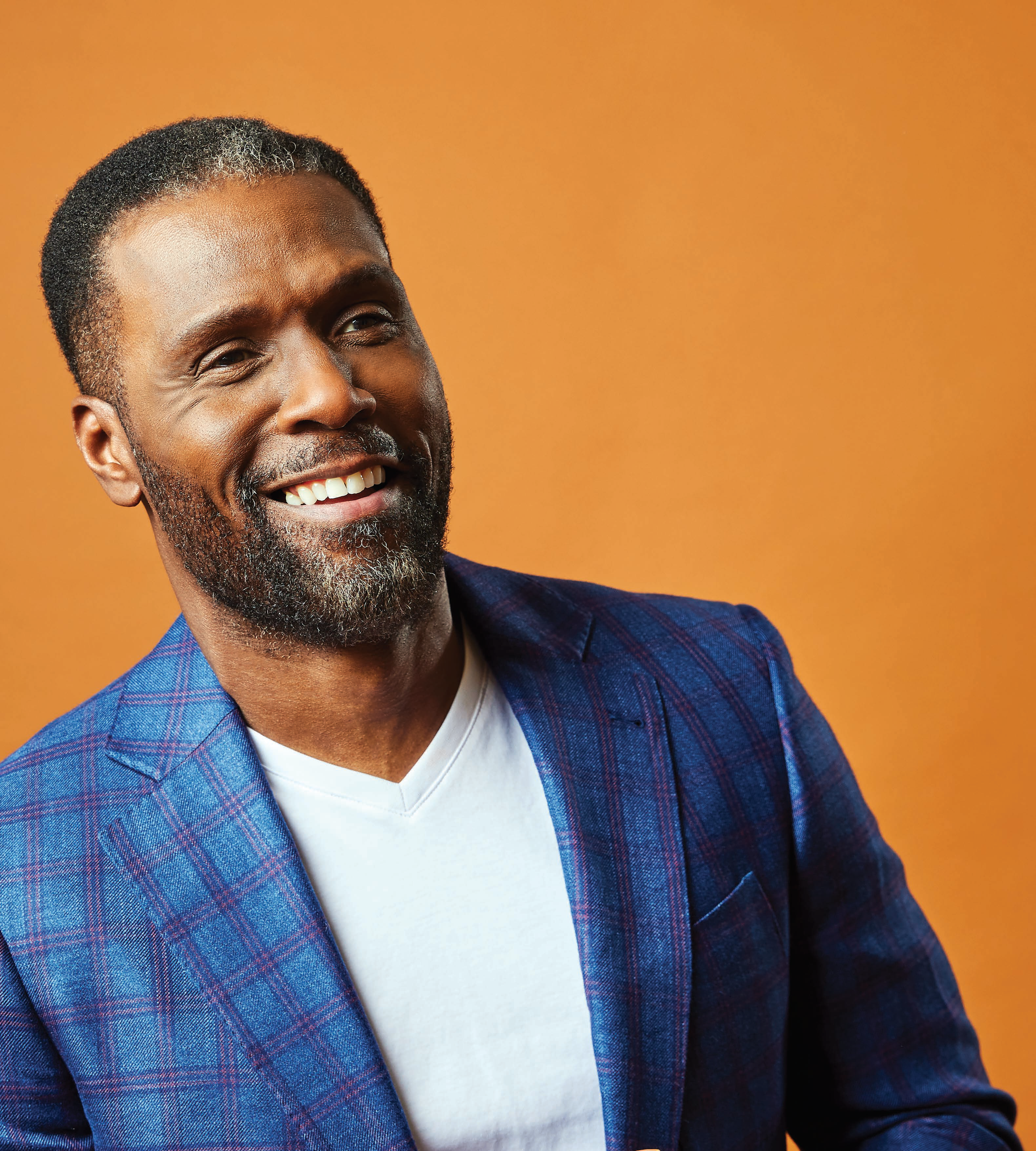
Laughing through every word, I was lucky enough to sit down for a virtual one-on-one with highly accredited actor of the stage and screen, Curtiss Cook. With a permanent smile plastered on his face during the entirety of our conversation, we dove in deep on the challenges of the modern-day actor and how one must master the art of using their whole body, “from your toes to the tip of your head” to create depth and emotion for the viewing audience.
My first question to Cook, which admittedly needs revising, was short but pretty loaded: Where are you right now? After raising his eyebrows and endearing me with a look, Cook began to laugh and answer as I squeezed in a quick “No pressure!”
“Oh wow! I was like where am I mentally…or physically?” Cook joked, overly annunciating each syllable and waving his hands in the air.
After I stopped laughing, I was able to fully listen to his answer. Having recently completed one of the major highlights in his professional portfolio, Cook talked about his involvement in Steven Spielberg’s West Side Story. Cook played Abe, a newly written black role added to the story by Spielberg and screenwriter Tony Kushner in order to give a more realistic dimension to the film’s cast of characters. Presented with the opportunity to play a character created not only for the story, but with Cook in mind left the actor admittedly starstruck by the request.
“I'll tell you this. It was one of those ‘pinch me’ moments! Because initially, you get the call, and you really just want to say, Huh, me what? Hold on, what? Who? What, wait, wait, stop, stop, stop. You really want to do that for a minute, right?” Cook continued saying through his laughter, “And then and then you get an opportunity. You sit down and you have a conversation and you're talking with this person, and you realize that although they're a genius and they’re uber famous, they're just real people, right?” I nodded along, having come to a similar realization about the star staring back at me only five minutes ago.
The importance of the role left Cook humbled to be a part of the creative experience. “I have two grandchildren…and when they have grandchildren, they can actually pull this up one day and say, look, there's my grandfather creating this role that wasn't there before and have a conversation about it. It could be in colleges, it could be in high schools, it could be anywhere.”
Out of my own curiosity, I let Cook gush deeper about the famous director we were both so effortlessly name dropping. He let me know one of the greatest assets a director can bring to a production is the power of collaboration.
“Something else I kind of noticed when you kind of work with greats like Steven Spielberg is that it's not, a lot of the time, it's not about control… it's really about the collaborative effort.” Cook went on explaining, “When they're like hey, what do you feel? How does that feel for you? Is there anything else you want to do? You want to try something different? Saying whatever you'd like to do, go ahead and feel free, allows the artistry to really come out of an individual.”
This is one of the biggest pieces of advice Cook said he would give to any young and aspiring directors. “It's cool to have a vision. It's cool to have an idea of what you would like this to be and how you want it to be. But it can be even better when you begin to collaborate with your artists. And you allow the vision to grow to shape into something else that maybe you didn't think it could be.”
After getting so many positive reviews for not only his individual work on West Side Story, but for the movie as a whole, I asked Cook whether the good fortune has made a difference in the way he feels about the film.
“I mean, positivity is always good. And getting good reviews is always better than the opposite. But it's a slippery slope…I was proud of the project. When I got it, when I had the meetings, when I shot and when I was finished, I was already proud of it. So just having the world view it and also appreciating it the same way makes me feel good.” Cook continued, talking about the negative aspects of such a sensation. “I don't think that that would change my acceptance and love and appreciation and joy that I had connected with this. So, I always have to be very cautious with praise as well as criticism because I think if you take praise too much, you also have to take the criticism just as much. You can't really pick.”
I followed up by asking Cook if his selection process for projects is ever altered by the thought of public opinion, or if his choices are done independent of anyone else.
“I would be lying if I said it didn’t come to my mind. How much it comes to my mind is the big thing. I have a family of five children… and of course I'm married as well. Hi, honey!” Waving and smiling, “And sometimes I worry about the perception that I have for them more so than for myself…so, if I see a project, I would wonder what the intent behind the character is from the director's point of view.”
Cook went on saying he’s not afraid to pass on roles that don’t require his talents specifically. “If it's one of those things, I’ll be like, yeah, I've kind of done this a lot. You can probably find somebody else who may need an opportunity like I was given, to portray this character in a different way. But if it’s something that I've already done and I don't need to revisit it, I won’t.”
The esteemed Cook is currently shooting the fifth season of Showtime’s The Chi in Chicago, his home for the next few months. Explained best in his own words, Cook's character is, “A kind of villainous, smart, handsome, intriguing, conniving man who really cares about the city of Chicago.”
I asked the experienced actor if it’s different to work on a TV set compared to shooting a film. I was surprised to find out there's more nuance in the creative differences than there is in the physical working environment.
“On a movie set, primarily you're shooting for about six months. It could be anywhere from, you know, three weeks to six months depending on what type of movie and how much your character's involved in the movie. But in that time period, you're really able to just focus on that one storyline and that one major moment in the history of that character.” Cook elaborated saying, “But on the television show, primarily what happens is, although you kind of know the character if you've been able to do it, like I have with the show, this is my fourth season…sometimes you don't know what he's going to do from script to script.”
Cook described how when working on a project for television, it is often more spontaneous. “So, in a heartbeat you have to switch something around quickly. Which is cool and which is acting, which is the creative process, which is art, which I love.”
“Both mediums are amazing. Because they actually get an opportunity to show people a life that they maybe want to have or show them a life that they never wanted to have or show them about something that they never knew about.”
After asking more about his musical theater background, Cook took his time explaining to me the nuances of acting for a live audience, and the difference between evoking emotion with your whole body versus just within the frame.
“Musical theater will always be my first love…there's nothing like knowing that you’re being watched from your toes all the way to the tip of your head once you enter that stage from the proscenium. People can watch what they want to watch. They don't have to look at you, they can look over at a chair if they want to. Or if when they see you, they can just look at the top of your hairline if they want to or at your feet if they want to. And knowing that as an actor, that all of that has to live in this moment in that character.” Cook smiled saying, “I relish that because when you work in television they can pull in real tight and you know that this…” Making a box around his face with his hands, “…only has to work.”
Acting his way through the TV watch guide, best blockbuster releases and theatrical on-stage productions, Cook is a star worth looking out for. His intense search for humor in everything he does leaves no room for dismay, and I have no doubt we’ll be seeing him more and more in the faces of beloved characters as he carries on with his successful career.
Throughout our time speaking, Cook had described to me his experience in the industry from several different perspectives, including that of a supportive father encouraging his own prodigies from the sidelines. Some of his children have “definitely been bitten by the bug” and are following Cook’s footsteps in search of an acting career. Proud could only describe the look on his face as he told me about each of their individual paths to success.
A perfectly summed up parting message for not only his children, but any aspiring young go-getters desperate to lead a life as accomplished as our subject, was my last recorded quote from Cook.
“If you have a dream, follow it.”
Creative Credits
- Written by
- Elizabeth Grace Coyne
- Photography
- Meagan Shuptar
- Styling
- Katie Schuppler
- Styling assistant
- Grace Owen
- Hair & Makeup
- Jean Ramos
- Retouching
- Brianna Kish